400-188-1518
ONES vs Asana vs Monday vs ClickUp 2026: Enterprise R&D and General Project Management Comparison
Quick Verdict: Four Tools for Different Organizational Needs
Choosing between ONES, Asana, Monday, and ClickUp depends on your team size, technical complexity, and governance requirements. Here are four tools compared across enterprise R&D and general project management use cases:
- ONES — Best for mid-to-large engineering organizations needing unified R&D lifecycle management with governance and metrics.
- Asana — Best for teams prioritizing structured task execution with minimal configuration overhead.
- Monday — Best for cross-departmental visibility through visual, adaptable workflows.
- ClickUp — Best for cost-conscious teams seeking maximum customization depth.
None of these platforms alone answer whether a project was profitable. That requires integrating time-tracking intelligence, addressed later in this guide.
| Metric | ONES | Asana | Monday | ClickUp |
|---|---|---|---|---|
| Starting Price | Custom (enterprise-focused) | Free | Free | Free forever |
| Entry Paid Price (annual) | Custom | $10.99/user/mo | $9/user/mo | $7/user/mo |
| Mid-Tier Price (annual) | Custom | $24.99/user/mo | $12–19/user/mo | $12/user/mo |
| Learning Curve | Moderate (enterprise complexity) | Low to Moderate | Low to Moderate | Moderate to High |
| Key Differentiator | End-to-end R&D pipeline with governance | Clear task hierarchy and structure | Visual boards and cross-team dashboards | Deep customization and feature breadth |
| Automation Depth | Workflow orchestration across R&D stages | Rules-based automation (higher tiers) | Multi-step workflow automation | Highly customizable automation logic |
| Best For | Engineering orgs scaling R&D operations | Teams wanting structured execution | Teams needing visual cross-department coordination | Teams prioritizing customization and power |
| Ease of Onboarding | Guided (dedicated implementation) | Easy | Easy | Moderate |
| Native Time Tracking | Integrated with pipeline metrics | None (custom fields or integrations) | Limited (manual fields; add-on at higher tiers) | Built-in |
Last updated: 2026. Pricing based on annual billing where applicable.
ONES: Capabilities and Considerations
Where It Excels
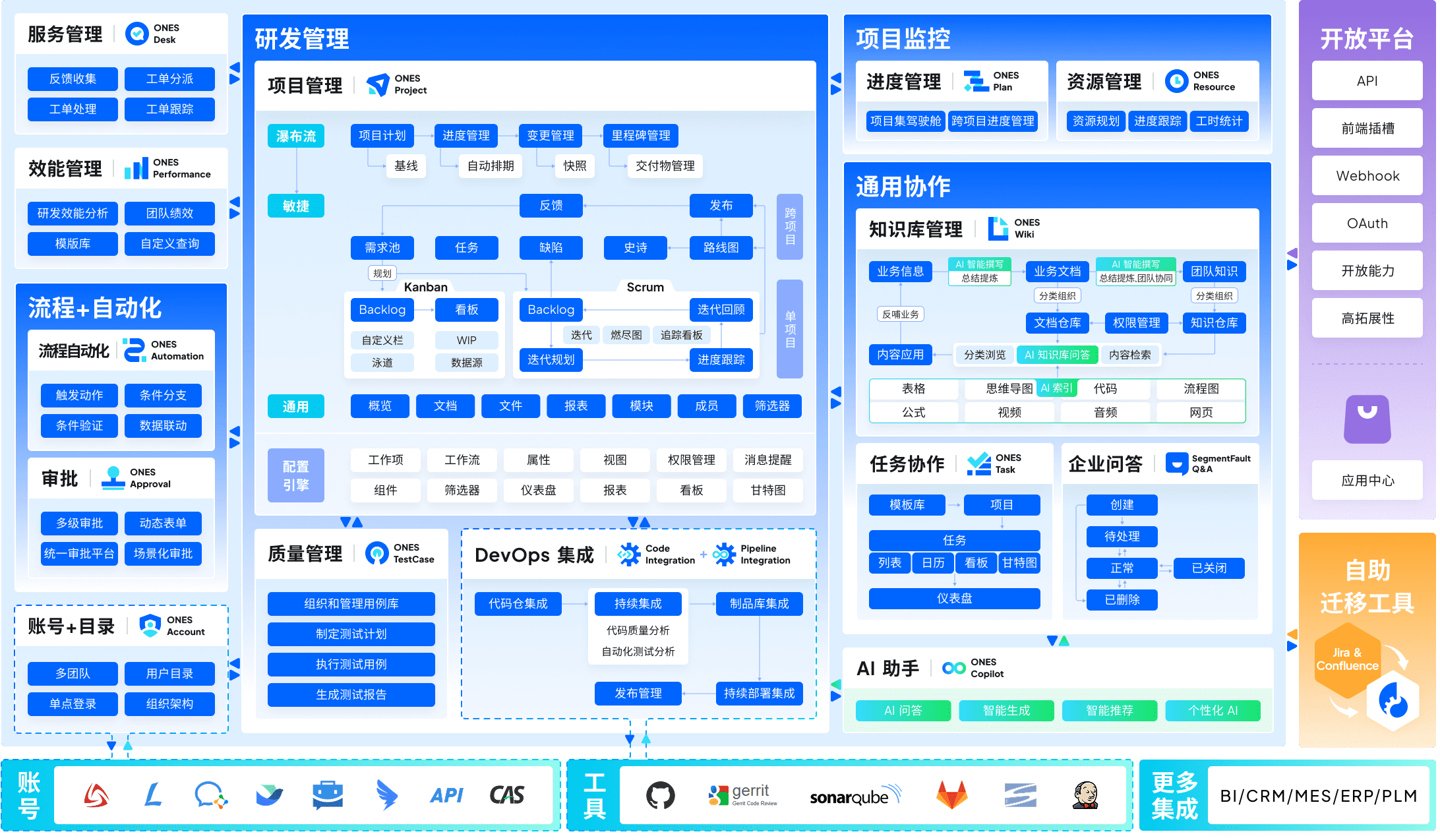
ONES distinguishes itself through comprehensive integration of the entire research and development workflow. Rather than connecting disparate tools for requirements, testing, documentation, and deployment, ONES consolidates these functions into a single platform. This architecture reduces the fragmentation that typically accumulates as engineering organizations adopt point solutions over time.
The platform’s governance framework supports sophisticated permission models and process configurations necessary for regulated industries or companies with strict release protocols. Cross-team collaboration features accommodate matrix structures where multiple engineering groups contribute to shared product lines.
Perhaps most notably, ONES embeds measurement capabilities throughout the development lifecycle. Teams can analyze cycle times, defect rates, deployment frequency, and other indicators without exporting data to separate analytics environments. This embedded metrics approach supports continuous improvement initiatives grounded in operational data rather than anecdotal assessment.
Where It Presents Trade-offs
The enterprise orientation of ONES means smaller teams or organizations without complex R&D processes may find the platform’s depth disproportionate to their needs. Implementation typically involves structured onboarding rather than self-service activation.
Cost structures reflect the platform’s target market, with custom pricing that positions ONES above entry-level alternatives. Organizations should evaluate total cost of ownership against the expense of maintaining multiple integrated tools.
Asana: Capabilities and Considerations
Where It Excels
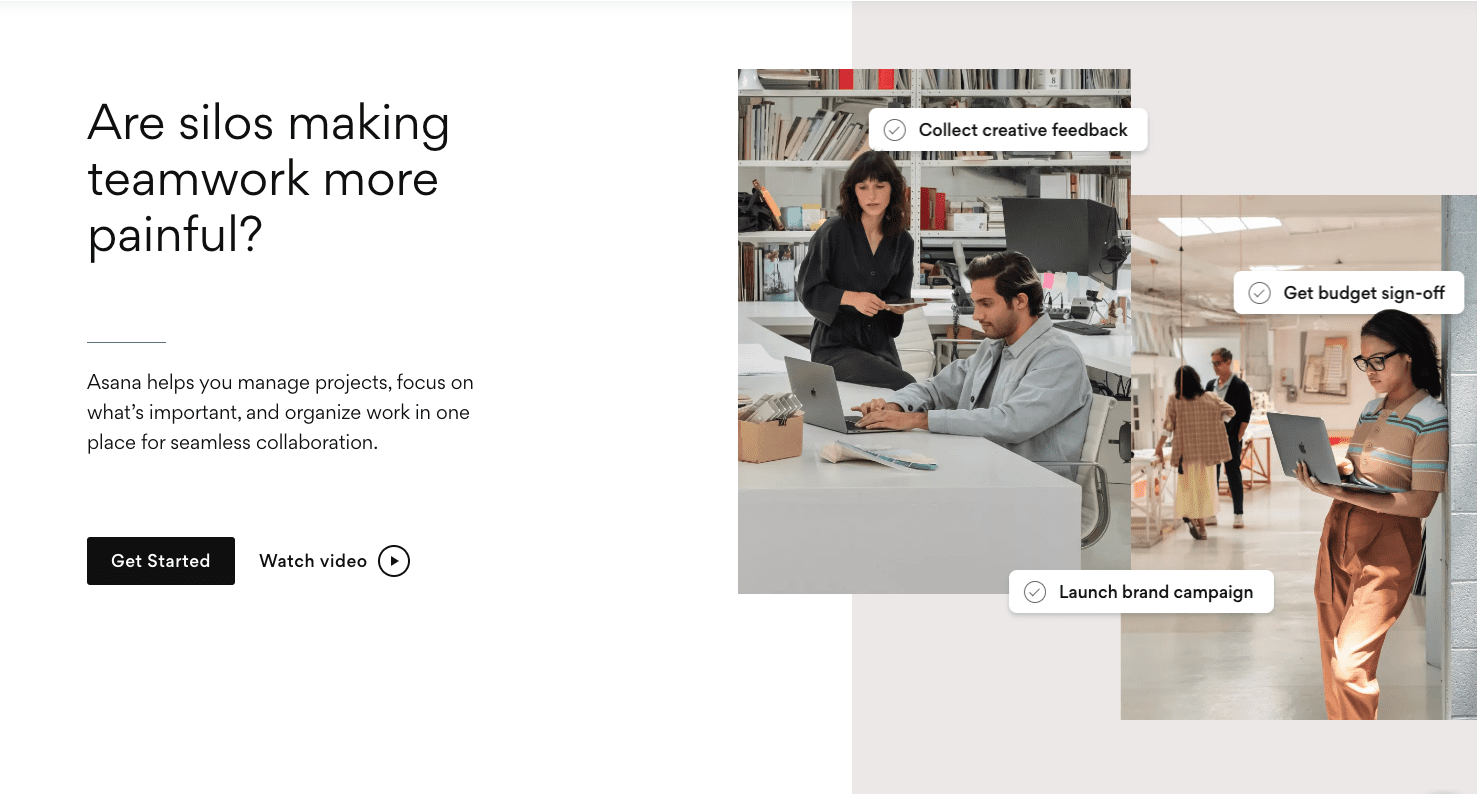
Asana maintains a reputation for interface clarity that reduces friction in daily task management. The relationship between tasks, subtasks, dependencies, and timelines remains visually coherent, which accelerates adoption across teams without extensive training investment.
Automation capabilities occupy a practical middle ground—sufficient for standardizing recurring workflows without demanding specialized configuration expertise. This balance proves particularly valuable for mid-market organizations scaling their operational discipline.
At higher subscription tiers, portfolio tracking and workload visualization provide program-level visibility that many competing platforms reserve for premium offerings or external integrations. The controlled user experience, in contrast to more expansive alternatives, often correlates with faster organizational uptake.
Where It Presents Trade-offs
Advanced functionality concentrates in higher-priced tiers, escalating per-user expenditure as requirements mature. Organizations anticipating growth in reporting or automation needs should model long-term costs carefully.
Configuration flexibility remains bounded compared to architecturally open platforms. Teams with unconventional workflow requirements or cross-functional processes extending beyond traditional project management may encounter structural constraints.
Collaboration features generate substantial notification volume that becomes unwieldy in large deployments without deliberate governance. Time tracking depends on manual entry or external supplementation, limiting native visibility into effort allocation.
Monday: Capabilities and Considerations
Where It Excels
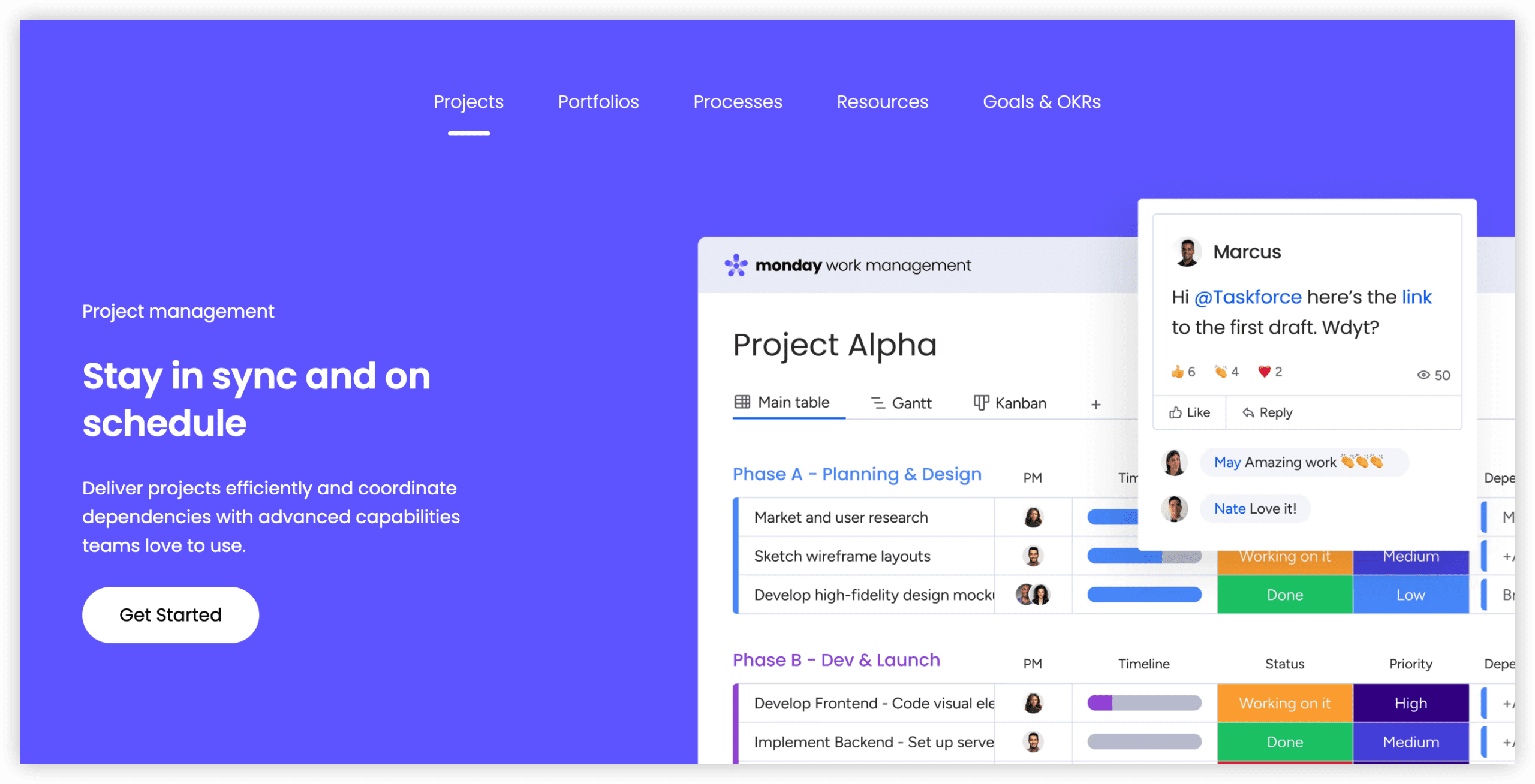
Monday’s visual architecture prioritizes immediate comprehension. Status columns, color-coded boards, and consolidated dashboards enable stakeholders to assess progress without navigating nested hierarchies or specialized views.
The platform’s dashboard capabilities aggregate information across multiple workspaces, supporting managerial oversight spanning departmental boundaries. This visibility characteristic explains Monday’s prevalence in operational contexts where coordination across marketing, sales, and fulfillment functions matters as much as project execution.
Automation logic at intermediate and advanced tiers accommodates conditional triggers and cross-board actions that transcend simple stimulus-response patterns. The interface design proves approachable for business users without technical backgrounds.
Where It Presents Trade-offs
Cost escalation accompanies capability expansion. Features frequently requested during scaling—advanced automations, workload management, time tracking—require plan upgrades that may exceed initial budget projections.
The flexibility that enables diverse use cases can undermine structural consistency. Without administrative standards, teams may construct incompatible board architectures that complicate cross-project analysis and reporting.
Seat-based pricing with minimum block purchases amplifies expense growth. Time tracking functionality arrives as a premium addition rather than core capability, pushing rigorous hour-tracking requirements toward specialized integrations.
ClickUp: Capabilities and Considerations
Where It Excels
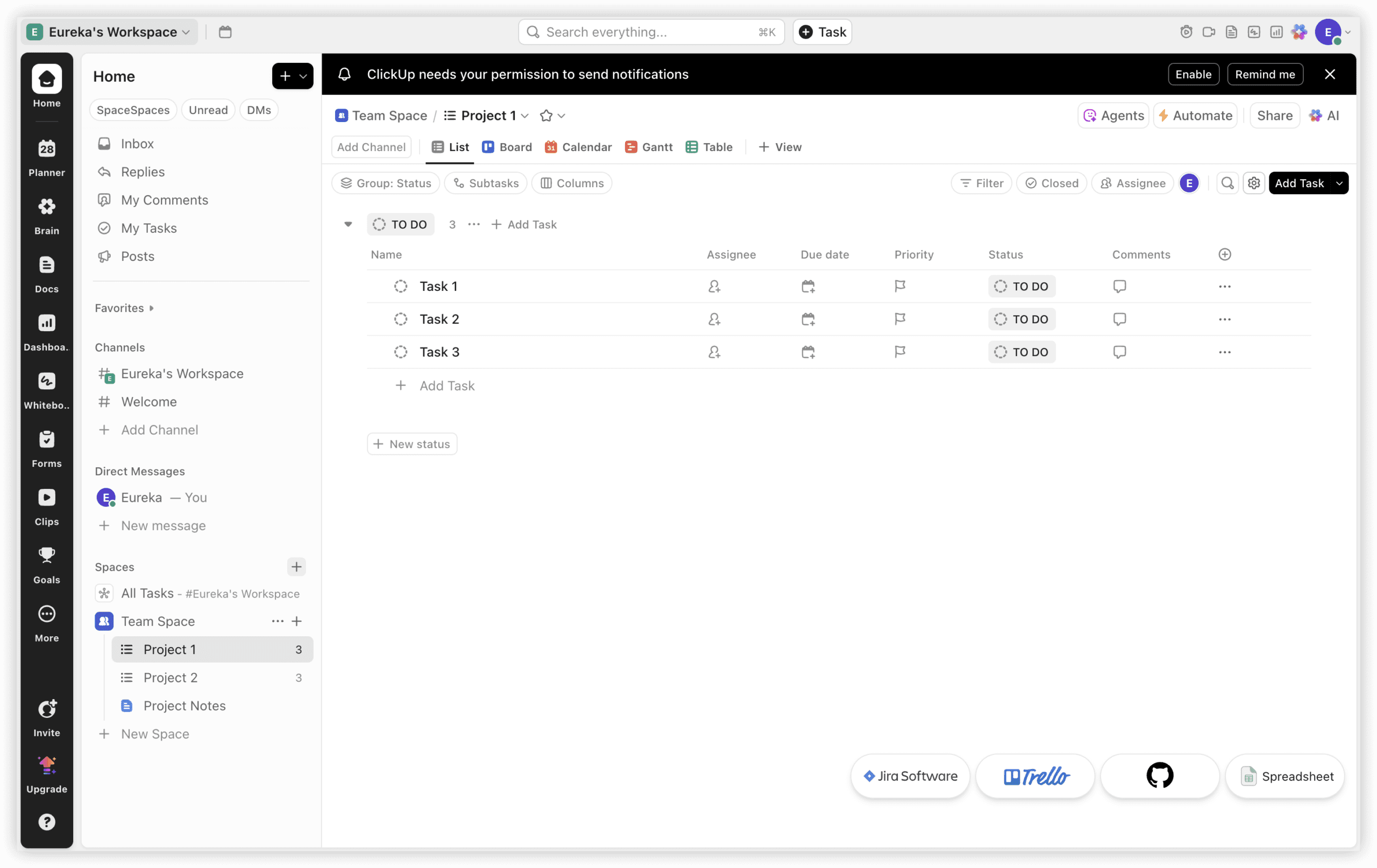
ClickUp’s architectural openness permits extensive tailoring of workflows, view configurations, automation logic, and information hierarchies. Organizations with well-defined operational models can replicate their processes with minimal compromise.
Feature inclusion at lower price points distinguishes ClickUp from tier-restricted competitors. Documentation, goal tracking, time monitoring, and dashboarding become available earlier in the subscription progression, improving accessible capability density.
Automation construction supports more elaborate conditional branching than Asana’s streamlined rule set. Native time tracking eliminates immediate integration requirements for basic effort visibility, though financial-grade reporting remains limited.
Where It Presents Trade-offs
Capability depth imposes cognitive load. Teams without dedicated administration resources may struggle to realize platform potential, and initial adoption curves extend beyond more prescriptive alternatives.
Workspace complexity tends to accumulate organically. Without disciplined maintenance, proliferating projects, views, and automations degrade navigability and system responsiveness in extensive deployments.
Performance variability surfaces in heavily customized or populated environments according to user reports. The time tracking module serves awareness purposes adequately but lacks the rate management, profitability computation, and approval workflows characteristic of dedicated time systems.
2026 Pricing Comparison
| Pricing Dimension | ONES | Asana | Monday | ClickUp |
|---|---|---|---|---|
| Free Offering | Trial/evaluation | ✅ | ✅ | ✅ (unlimited duration) |
| Entry Paid (annual) | Custom quotation | $10.99/user/mo | $9/user/mo | $7/user/mo |
| Entry Paid (monthly) | Custom quotation | $13.49/user/mo | $12/user/mo | $10/user/mo |
| Mid-Tier (annual) | Custom quotation | $24.99/user/mo | $12–19/user/mo | $12/user/mo |
| Enterprise | Custom quotation | Custom pricing | Custom pricing | Custom pricing |
| Value Concentration | Governance and metrics at scale | Structure and portfolio features | Visual accessibility | Feature breadth at low entry cost |
| Minimum Seats | Negotiated | 1 | 3 | 1 |
Direct Comparisons by Decision Scenario
ONES vs. Asana
Select ONES when: Your organization manages complex software development with multiple handoffs between requirements, implementation, verification, and release stages; governance and audit requirements demand granular permission control; engineering efficiency measurement informs strategic decisions.
Select Asana when: Project structures follow relatively standardized patterns; teams prioritize rapid deployment without extensive configuration; cross-functional participants span technical and non-technical roles with varying tool sophistication.
Decision principle: ONES serves R&D-centric enterprises with lifecycle governance requirements; Asana serves general project execution with emphasis on clarity and speed.
ONES vs. Monday
Select ONES when: Development pipeline integrity outweighs broad departmental accessibility; metrics-driven process improvement is institutional priority; tool consolidation reduces integration maintenance burden.
Select Monday when: Visual communication across diverse organizational functions matters as much as task execution; non-technical team members constitute significant user population; operational dashboards serve multiple stakeholder levels.
Decision principle: ONES optimizes for engineering depth and governance; Monday optimizes for organizational breadth and visual accessibility.
ONES vs. ClickUp
Select ONES when: Pre-built R&D workflow patterns match organizational processes; enterprise support and implementation guidance justify investment; unified data model enables systemic efficiency analysis.
Select ClickUp when: Budget constraints prioritize feature access over integrated architecture; internal capacity exists for platform customization and maintenance; workflow patterns deviate substantially from standard software development models.
Decision principle: ONES provides engineered integration for established R&D organizations; ClickUp provides configurable openness for cost-sensitive or structurally unique environments.
Asana vs. Monday
Select Asana when: Task hierarchy clarity supports accountability structures; portfolio management spans numerous concurrent initiatives; automation requirements remain within standard business process patterns.
Select Monday when: Visual progress representation accelerates stakeholder comprehension; cross-departmental coordination requires shared dashboard references; use cases extend into CRM, marketing operations, or other non-project domains.
Decision principle: Asana emphasizes controlled structure; Monday emphasizes adaptable visualization.
Asana vs. ClickUp
Select Asana when: Onboarding speed influences adoption success; team members express preference for prescriptive over configurable interfaces; automation scope remains within rules-based patterns.
Select ClickUp when: Workflow specificity demands architectural flexibility; feature requirements exceed Asana’s tier-structured offerings; cost efficiency enables broader user licensing.
Decision principle: Asana trades configurability for immediacy; ClickUp trades immediacy for extensibility.
Monday vs. ClickUp
Select Monday when: Visual intuition supports diverse user populations; dashboard consolidation serves managerial reporting needs; incremental capability expansion aligns with budget planning.
Select ClickUp when: Unit cost scaling enables larger deployments; automation complexity exceeds Monday’s tier limitations; documentation and goal tracking integration reduces tool proliferation.
Decision principle: Monday prioritizes accessible presentation; ClickUp prioritizes functional comprehensiveness.
Selection by Organizational Profile
| Organization Type | Recommended Platform | Rationale |
|---|---|---|
| Enterprise R&D / Software companies | ONES | Unified pipeline, governance, and metrics for complex development at scale |
| Agencies and consultancies | ClickUp | Client-specific customization and cost-controlled feature access |
| Product development teams | Asana or ONES | Structured execution for general use; integrated R&D for engineering-focused organizations |
| Operations and business units | Monday | Cross-functional visibility and approachable visual coordination |
| Early-stage ventures | Asana (simplicity) or ClickUp (capability) | Speed-to-value versus future-proofing trade-off |
| Scaling organizations | ONES or ClickUp | Governance and metrics as complexity increases; or configurable expansion path |
The Profitability Question: Beyond Task Completion
All four platforms reviewed here improve project organization, execution visibility, and team coordination. None natively resolve whether delivered work generated appropriate return on invested effort. Task completion, timeline adherence, and resource allocation visibility differ fundamentally from financial performance understanding.
Determining project profitability requires correlating time expenditure with revenue or cost attribution. This demands granular time capture, rate application, and analytical presentation that project management platforms treat peripherally if at all. ONES integrates time metrics within development pipeline analysis; ClickUp includes basic time logging; Asana and Monday defer substantially to external supplementation.
Organizations for whom effort economics drive strategic decisions should evaluate dedicated time intelligence layers that operate across whichever project platform they select. The project management choice determines how work is structured; the time analytics choice determines whether that structure yields sustainable returns.
Concluding Guidance
The 2026 project management landscape offers genuine alternatives rather than universally superior solutions. ONES addresses the specific complexity of enterprise research and development with integrated lifecycle governance. Asana, Monday, and ClickUp serve broader project coordination with varying emphases on structure, visualization, and configurability.
Final selection should derive from honest assessment of organizational maturity, technical requirements, growth trajectory, and total cost expectations rather than feature checklist comparison. The most capable platform is the one your organization can implement effectively, adopt consistently, and adapt sustainably.
Frequently Asked Questions
Which platform best supports software development teams specifically?
ONES is purpose-built for this context, with native requirements management, test integration, release coordination, and development metrics. General-purpose platforms require more extensive customization or integration to approximate equivalent coverage.
How do implementation timelines compare across these options?
Asana and Monday typically enable self-service deployment within days. ClickUp may require weeks for configuration optimization. ONES generally involves structured implementation measured in weeks to months depending on organizational scale and integration complexity.
Is migrating between these platforms difficult?
Migration complexity increases with data volume, customization depth, and integration entanglement. Standard task and project data transfers relatively cleanly; automation rules, dashboard configurations, and historical metrics typically require reconstruction.
What role does artificial intelligence play in these platforms as of 2026?
AI capabilities vary and evolve rapidly. Current implementations focus on task generation assistance, status summarization, and predictive scheduling. Evaluate specific claims against demonstrated functionality during trial periods, as marketing descriptions often precede practical utility.
How should organizations with limited technical administration capacity choose?
Prioritize platforms with stronger prescriptive guidance and managed service options. Asana and Monday offer more approachable self-administration. ONES provides implementation support appropriate to its enterprise positioning. ClickUp’s openness demands proportionally greater internal governance investment.