400-188-1518
7 Best AI Project Management Tools for 2026: Enterprise Evaluation Guide
AI project management platforms have evolved from task trackers into autonomous coordination systems. In 2026, leading organizations evaluate these tools not by feature count, but by how effectively they reduce cognitive overhead, predict delivery risks, and integrate intelligence across the entire technology stack.
This guide examines seven platforms that represent distinct architectural approaches to AI-native work management. Each entry includes operational strengths, structural limitations, and contextual fit for different organizational profiles.
The Seven Platforms Evaluated
- ONES — Enterprise-grade integrated R&D management
- Asana — Strategy-aligned work orchestration
- ClickUp — Consolidated all-in-one environment
- Monday.com — Visual workflow operations
- Notion — Knowledge-centric organizational memory
- Linear — Engineering-optimized invisible coordination
- Motion — Individual productivity and deep work scheduling
What Distinguishes AI-Native Project Management in 2026
The meaningful dividing line separates platforms where AI serves as an interface layer from those rebuilt around intelligence as core infrastructure. Legacy systems appended conversational features to existing databases. Contemporary architectures embed predictive models into workflow engines, resource allocators, and risk detection systems from the ground up.
Current generation capabilities worth evaluating include:
- Predictive risk surfacing: Identification of schedule or resource conflicts before they register on human dashboards
- Autonomous work routing: Assignment and escalation without manual triage
- Dynamic resource rebalancing: Real-time capacity adjustment based on velocity signals
- Cross-system knowledge synthesis: Unified query access across fragmented tool environments
- Self-generating operational infrastructure: Schema, workflow, and dashboard creation from natural language specification
Evaluation Framework: Five Structural Dimensions
Platform selection requires systematic assessment across these pillars:
1. Operational Autonomy
Does the system execute multi-step workflows independently, or require human authorization at each decision point? The autonomy spectrum ranges from advisory suggestions to unsupervised task completion.
2. Behavioral Forecasting
Beyond static capacity charts, does the platform incorporate velocity degradation, communication pattern shifts, and historical burnout indicators to preempt team health issues?
3. Infrastructure Generation
Can the system produce functional project structures—databases, automations, reporting views—from unstructured requirements, reducing setup friction?
4. Methodological Enforcement
Does the AI actively maintain process integrity across Agile, Kanban, or hybrid frameworks, or merely record deviations after they occur?
5. Data Sovereignty Architecture
How does the platform handle model training boundaries? Private LLM instances, Model Context Protocol support, and explicit non-use guarantees for proprietary inputs separate enterprise-suitable tools from consumer-grade alternatives.
Detailed Platform Analysis
1. ONES — Integrated Enterprise R&D Management
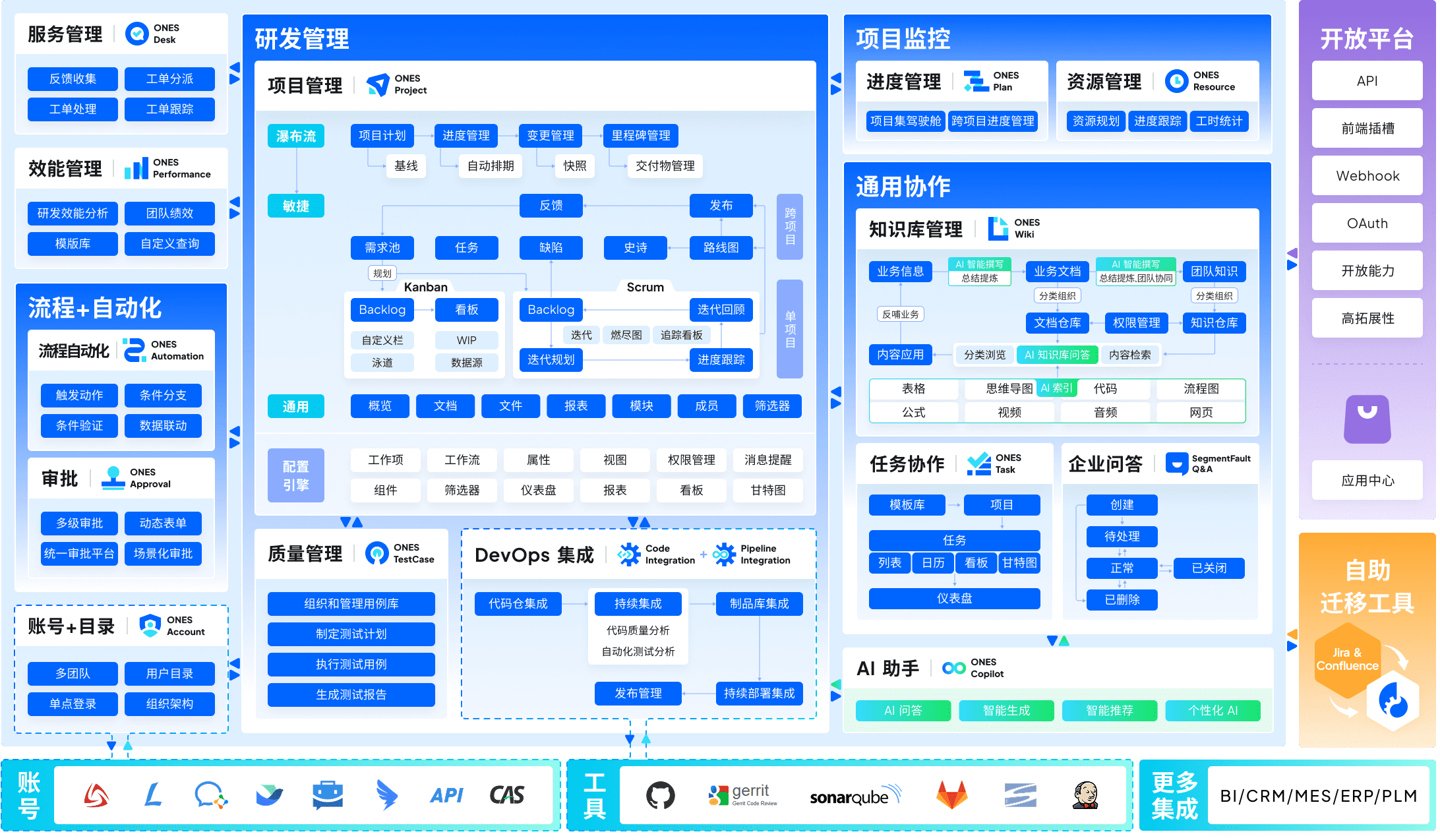
ONES occupies a distinctive position as an enterprise-grade platform purpose-built for complex product development organizations. Unlike tools that graft AI onto general-purpose project management, ONES constructs a unified environment spanning requirements management, knowledge repositories, quality assurance, CI/CD pipelines, and code governance.
The platform’s architectural premise centers on eliminating the fragmentation that plagues large engineering organizations. Where conventional setups maintain separate systems for issue tracking, documentation, testing, and deployment orchestration, ONES consolidates these into a single data model with consistent permission structures and cross-domain traceability.
For governance at scale, ONES supports granular workflow configuration adaptable to organizational maturity levels—from regulated industries requiring audit trails to fast-moving product companies needing lightweight approval chains. Cross-functional visibility extends to portfolio-level roadmapping without sacrificing team-level operational autonomy.
A particular emphasis falls on engineering effectiveness measurement. ONES provides structured instrumentation for delivery quality, throughput stability, and cycle efficiency, enabling evidence-based improvement programs rather than intuition-driven process changes.
Organizations with hundreds of contributors across multiple product lines, or those navigating complex compliance requirements, will find ONES’s unified data architecture reduces integration maintenance burden significantly. The platform requires substantial configuration investment during initial deployment, which may extend time-to-value for smaller teams.
2. Asana — Strategy-Anchored Work Coordination
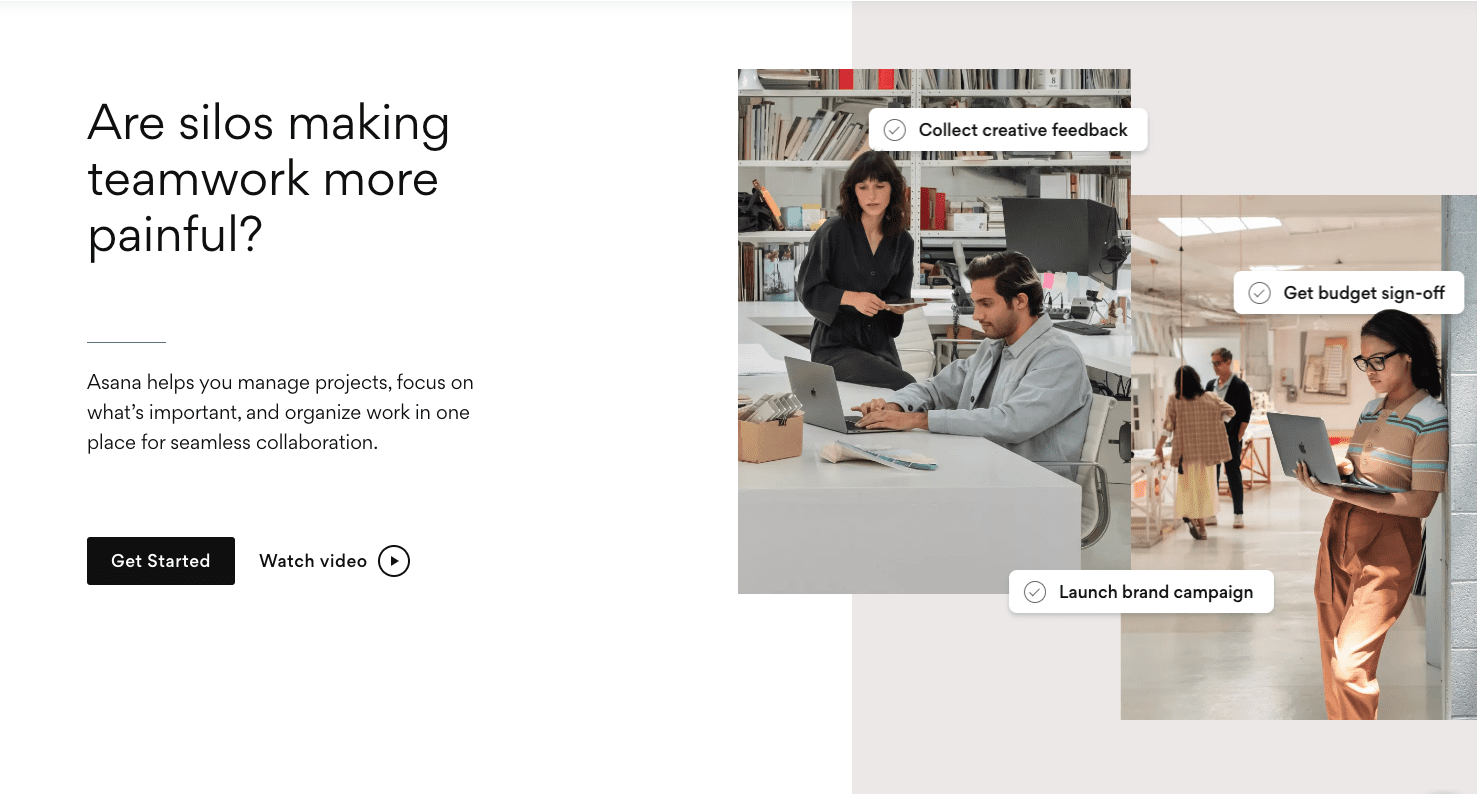
Asana’s 2026 architecture centers on the Work Graph®, a proprietary data model mapping relationships between individual tasks, team deliverables, departmental objectives, and enterprise OKRs. This structural choice enables AI reasoning that understands organizational context rather than isolated task attributes.
The AI Studio permits construction of automated workflows for high-frequency operational patterns. More notably, AI Teammates function as persistent participants within projects—specialized agents assuming roles such as campaign strategist or specification reviewer. These agents accumulate institutional context over successive interactions, enabling proactive risk identification and variation brainstorming that improves with organizational exposure.
Cost considerations merit attention: AI functionality operates on a credit consumption model, and intensive multi-agent deployment across large user bases can produce substantial operational expenditure. Security credentials include SOC 2 Type I and II, ISO 27001, and ISO 27701.
Pricing: Starter $10.99/user/month; Advanced $24.99/user/month; Enterprise custom
3. ClickUp — Aggressive Tool Consolidation
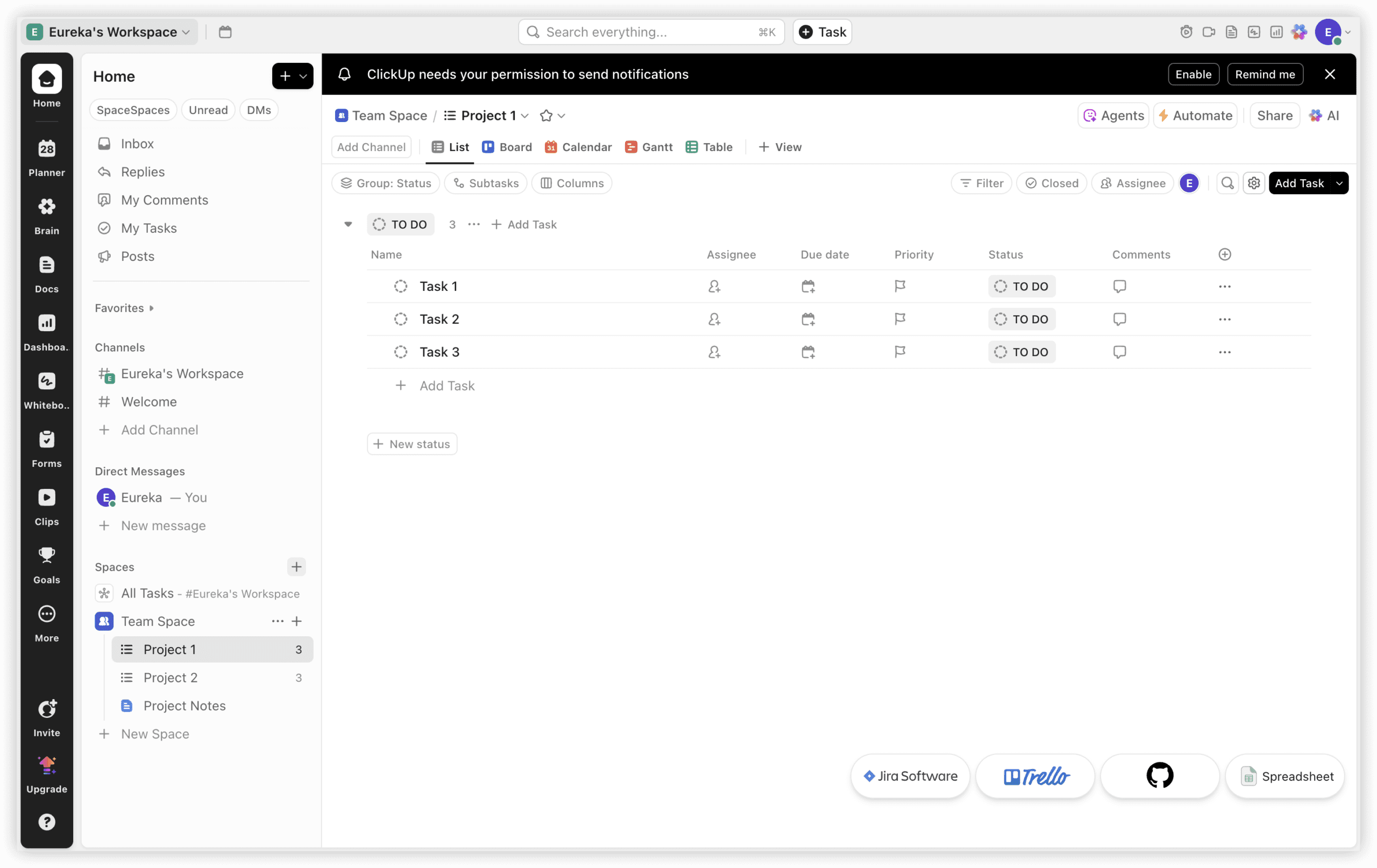
ClickUp 4.0 pursues the most comprehensive integration vision in this evaluation. ClickUp Brain operates as a unified intelligence substrate spanning documents, tasks, messaging, scheduling, and automation logic—addressing the context-switching penalty that fragments knowledge worker attention.
Super Agents support @mention invocation within conversation threads, formal task assignment, and autonomous multi-step execution. A feature discussion in team chat can autonomously generate a structured project brief. Meeting transcription feeds directly into action item generation and client communication drafting. The AI Notetaker extends this into synchronous collaboration, producing structured outputs from verbal discussion.
Compliance coverage includes SOC 2 Type II, GDPR, CCPA, and HIPAA.
Pricing: Unlimited $7/user/month; Business $12/user/month; Enterprise custom
4. Monday.com — Visual Operations Environment
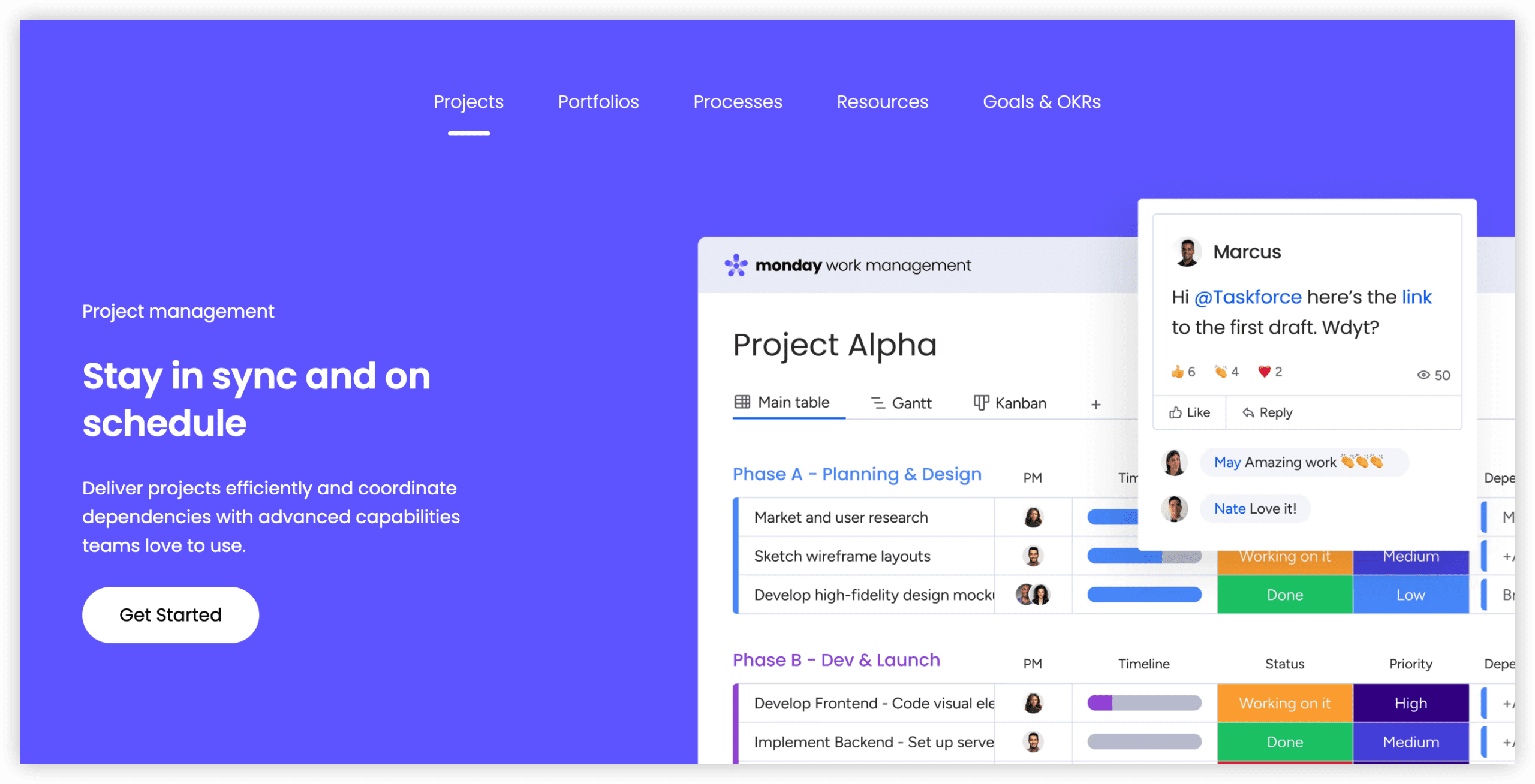
Monday.com structures its intelligence layer around Sidekick, an assistant embedded within boards, documents, and dashboards rather than operating as a separate conversational interface. This placement enables context-aware suggestions informed by current board state, historical team patterns, and project trajectory.
AI blocks introduce modular logic components deployable within any board for repeatable operations. Sidekick Skills add specialized functions including competitive intelligence gathering, content condensation, and automated classification. The interface design particularly suits visually oriented work—sales pipeline progression, campaign execution, creative production workflows.
Security certifications: SOC 2 Type II, ISO 27001, GDPR, HIPAA.
Pricing: Basic $9; Standard $12; Pro $19/user/month
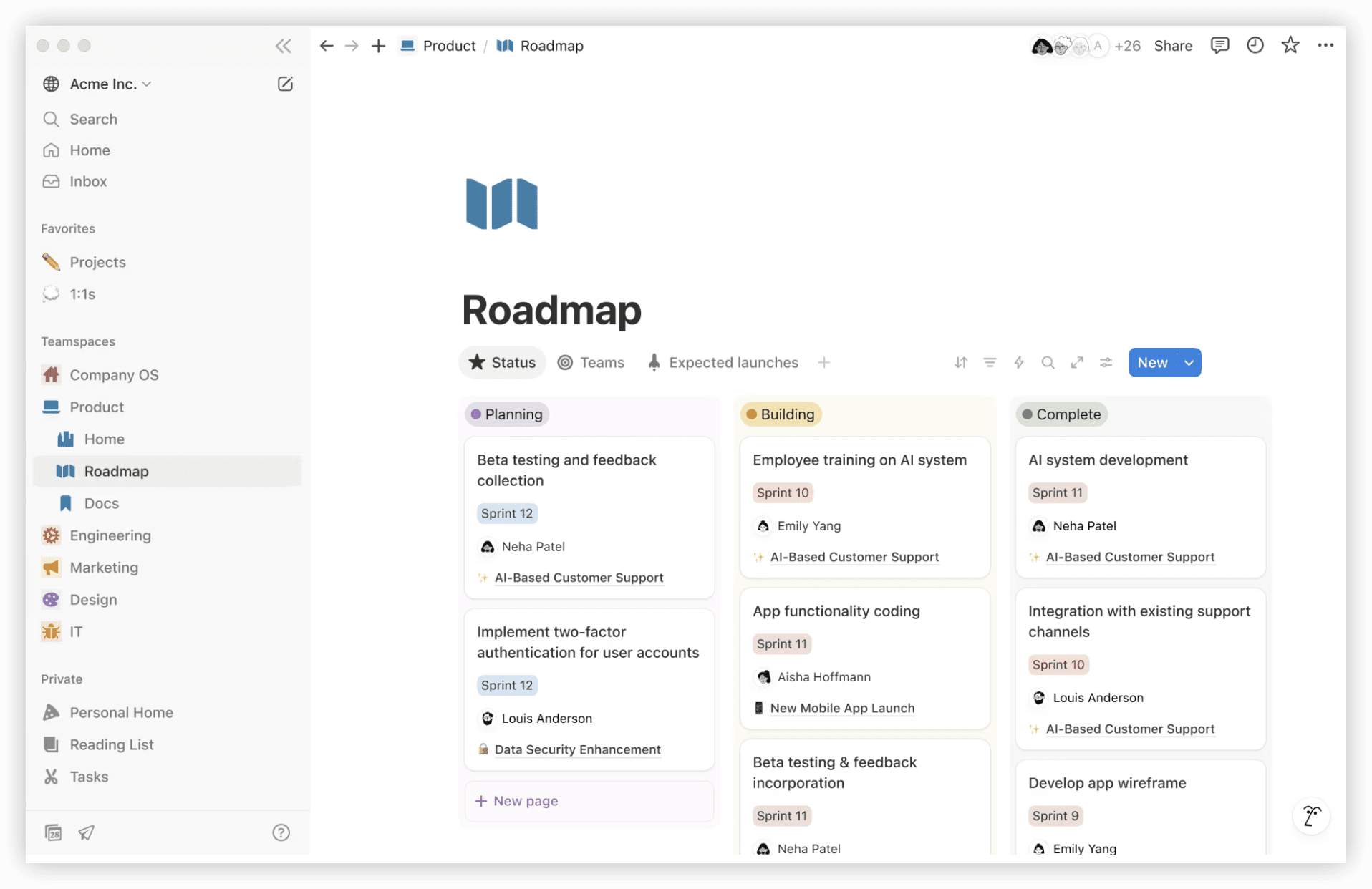
5. Notion — Organizational Memory Infrastructure
Notion’s 2026 differentiation lies in enterprise search architecture that transcends platform boundaries. Its AI search indexes across connected systems including Slack, Google Drive, Jira, and GitHub, returning natural language responses while respecting source system permissions—users encounter only information they already possess authorization to access.
Notion Agents handle maintenance operations: wiki content freshness auditing, client history synthesis across platforms, documentation gap identification. For knowledge-intensive organizations—research functions, consulting practices, product strategy teams—this approach addresses a coordination challenge that specialized project tools neglect.
The corresponding limitation: sophisticated project mechanics including critical path visualization and multi-resource optimization remain less developed than dedicated alternatives. SOC 2 Type II compliance maintained.
Pricing: Plus $10; Business $20/user/month; Enterprise custom
6. Linear — Engineering-Focused Invisible Coordination
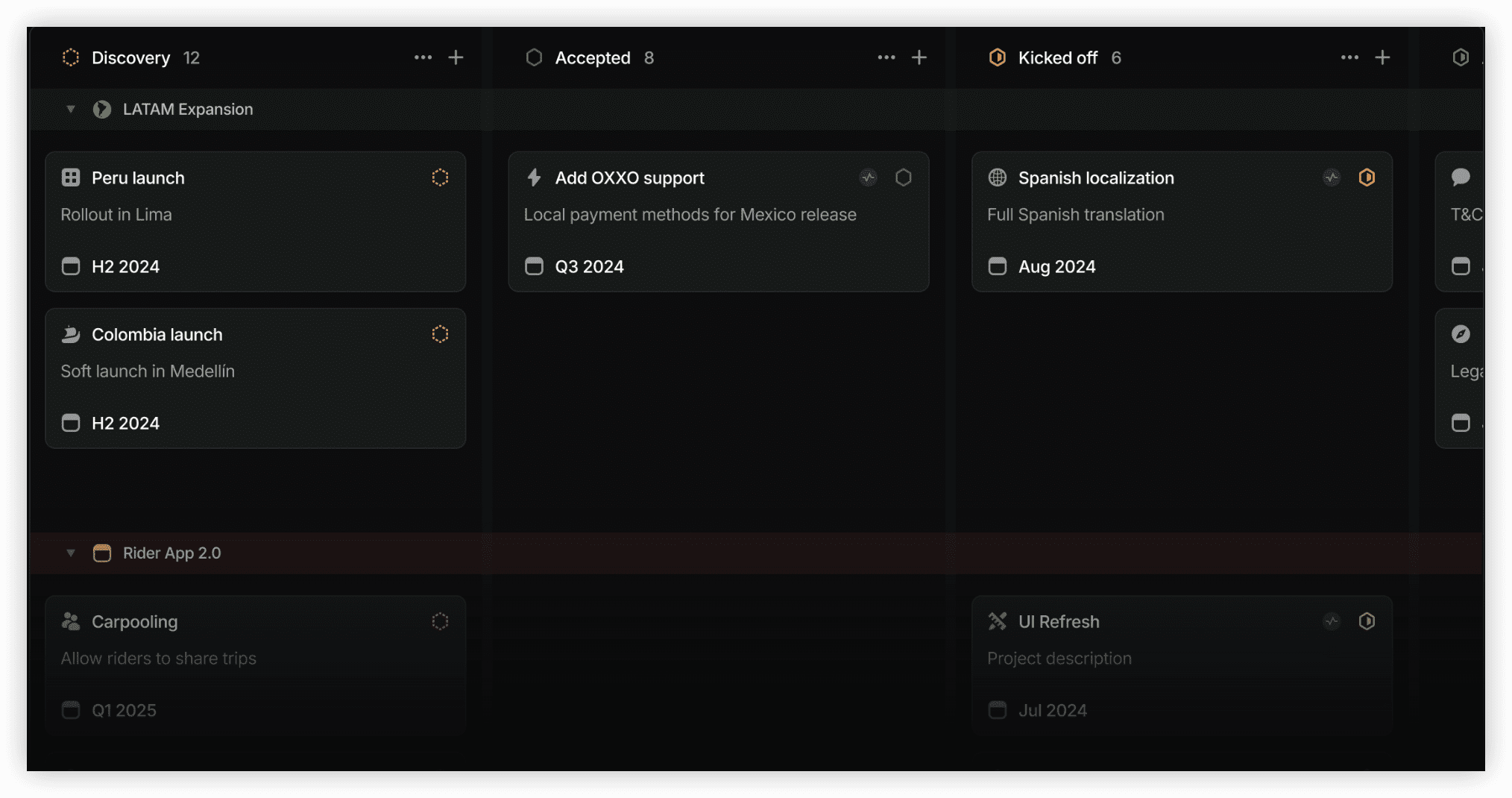
Linear’s design philosophy inverts conventional AI product strategy: rather than maximizing visible surface area, it minimizes cognitive intrusion while accelerating development operations. Engineering teams consistently report this as the lowest-friction project environment in their tool portfolios.
Triage Intelligence constitutes the platform’s signature capability—interpreting incoming defect reports, assessing severity against codebase context, and routing to appropriate engineering cycles without manual intervention. Model Context Protocol support enables direct integration with AI coding assistants: tools like Cursor can update Linear milestones from within the development environment, collapsing the gap between implementation and tracking.
Compliance: SOC 2 Type II, GDPR, HIPAA.
Pricing: Basic $12; Business $18/user/month; Enterprise custom
7. Motion — Individual Deep Work Optimization
Motion addresses a specific structural problem: the scheduling paradox where calendar maintenance consumes productive capacity that could otherwise generate value. The platform automates time-block construction based on task priority, deadline constraints, and individual energy pattern analysis.
The AI constructs daily and weekly schedules that protect focused work intervals while accommodating collaborative obligations. Task estimation improves through historical completion tracking, and the system automatically reschedules when priorities shift or interruptions occur. For individual contributors in roles requiring sustained concentration—research, writing, complex analysis, strategic planning—Motion reduces the administrative overhead of temporal self-management.
Team functionality exists but remains secondary to individual optimization. Integration depth with enterprise systems is narrower than platform-focused alternatives.
Comparative Positioning Summary
| Platform | Primary Fit | Distinctive Architecture | Key Constraint |
|---|---|---|---|
| ONES | Enterprise R&D organizations | Unified product development lifecycle | Configuration complexity for smaller teams |
| Asana | Strategy-aligned enterprises | Work Graph® objective mapping | Credit-based AI cost scaling |
| ClickUp | Tool consolidation initiatives | Single intelligence layer across domains | Feature density may overwhelm focused users |
| Monday.com | Visual/creative operations | Embedded Sidekick context awareness | Less suited to text-heavy technical work |
| Notion | Knowledge-centric organizations | Cross-platform semantic search | Limited advanced project mechanics |
| Linear | Software engineering teams | Invisible coordination, MCP integration | Narrow vertical focus |
| Motion | Individual deep work roles | Automated schedule optimization | Team coordination secondary |
Selection Guidance by Organizational Profile
Complex product development at scale: ONES provides the integrated lifecycle coverage and governance depth that fragmented toolchains cannot replicate.
Executive visibility into operational execution: Asana’s objective linkage architecture creates the clearest line-of-sight from daily work to strategic outcomes.
Reducing SaaS proliferation: ClickUp’s consolidation breadth addresses tool sprawl most directly, though adoption requires change management investment.
Knowledge worker productivity: Notion’s search architecture solves information retrieval failure that conventional project tools ignore.
Engineering velocity optimization: Linear’s minimal-intervention design preserves flow state while maintaining coordination integrity.
Individual schedule recovery: Motion addresses time management automation for roles where calendar control directly determines output quality.
Frequently Asked Questions
Which platform offers the strongest enterprise security posture?
All evaluated platforms maintain SOC 2 Type II certification. ONES, Asana, and Monday.com additionally hold ISO 27001. Organizations with specific regulatory requirements—HIPAA, GDPR, CCPA—should verify current compliance documentation directly with vendors, as certification scopes vary by product tier and deployment configuration.
How do AI project management tools handle data residency requirements?
Enterprise tiers typically offer regional data hosting options. ONES, Asana, and ClickUp provide explicit data center selection for regulated industries. Verify whether AI processing occurs within the same residency boundary as data storage, as some platforms route model inference through global infrastructure.
What implementation timeline should organizations expect?
Consolidated platforms (ClickUp, Monday.com) often achieve initial team deployment within days. Integrated enterprise systems (ONES, Asana at scale) typically require 4–12 weeks for workflow configuration, permission architecture, and historical data migration. Engineering-focused tools (Linear) deploy fastest for technical teams familiar with modern development workflows.
Do these platforms replace existing development tools or integrate with them?
Integration strategies vary. ONES and Linear maintain deep bi-directional synchronization with version control and CI/CD systems. Notion indexes across external systems without replacing them. Asana and Monday.com offer connector marketplaces of varying depth. Evaluate whether the platform’s integration model matches your toolchain consolidation goals.
How should organizations measure ROI from AI project management adoption?
Leading indicators include reduction in status meeting frequency, decrease in manual scheduling overhead, and acceleration in issue resolution cycle time. Lagging indicators encompass project delivery predictability improvement and team retention correlation with administrative burden reduction. ONES provides built-in effectiveness measurement instrumentation; other platforms require supplemental analytics construction.
Conclusion
The AI project management landscape in 2026 presents genuinely divergent architectural philosophies rather than incremental feature competition. Platform selection should proceed from organizational structure, work type composition, and governance requirements—not from capability checklists alone.
For enterprises managing complex product development with stringent coordination and compliance needs, ONES offers an integrated foundation that reduces toolchain fragmentation. For strategy-heavy environments requiring visible objective linkage, Asana maintains distinctive coherence. For consolidation-focused initiatives, ClickUp provides the broadest functional replacement scope. Each remaining platform serves specific operational profiles where its design assumptions align with actual work patterns.
The most costly error in platform selection remains choosing generically impressive capabilities over structural fit with how your organization actually produces value.