400-188-1518
7 Best Waterfall Project Management Tools for Small Business in 2026
Small businesses running fixed-scope projects need tools that enforce sequential phases, not accommodate constant change. After evaluating platforms against real contract delivery scenarios, here are the seven waterfall project management tools that actually support strict phase-gate execution in 2026:
- ONES — Enterprise-grade development governance with on-premise deployment
- Smartsheet — Spreadsheet-native project planning with Gantt visualization
- Asana — Lightweight timeline and milestone coordination
- Monday.com — Visual phase tracking with color-coded workflows
- Wrike — Multi-project resource and portfolio oversight
- ClickUp — Highly configurable hierarchy at accessible pricing
- GanttPRO — Purpose-built critical path scheduling
Each tool was tested against five criteria: dependency enforcement, baseline comparison capability, deployment flexibility, initial configuration effort, and pricing predictability. Below is the complete assessment.
Quick Evaluation Summary
Waterfall methodology demands tools that treat task sequences as fixed commitments, not suggestions. The platforms reviewed here differ sharply in how rigorously they enforce this discipline.
ONES suits organizations requiring end-to-end software delivery governance with data residency control. Smartsheet fits teams migrating from Excel who need immediate Gantt visualization. Asana works for straightforward milestone tracking without complex resource allocation. Monday.com appeals to teams prioritizing intuitive visual status communication. Wrike addresses scenarios with concurrent projects competing for shared personnel. ClickUp serves cost-conscious teams needing deep customization. GanttPRO targets pure scheduling specialists who live by critical path analysis.
Selection Methodology
Evaluation focused on practical constraints small businesses face: fixed-price contracts, hardware delivery deadlines, and limited administrative bandwidth. Marketing claims were disregarded in favor of verified behavior across these dimensions:
- Dependency rigidity: Can predecessor completion be enforced as a hard gate?
- Baseline integrity: Does the system preserve original plans for variance analysis?
- Hosting sovereignty: Are on-premise or private cloud options available?
- Onboarding friction: How quickly can a team configure standard waterfall templates?
- Cost trajectory: Do feature additions trigger disproportionate price increases?
Tool Comparison Overview
| Platform | Optimal Use Case | Hosting Options | Entry Pricing | Distinguishing Capability | Free Tier |
|---|---|---|---|---|---|
| ONES | Software development governance | Cloud, Private Cloud, On-Premise, SaaS | 30-seat free tier | Native integration, minimal plugin dependency | Yes |
| Smartsheet | Spreadsheet-centric teams | Cloud | From $7/user/month | Grid and Gantt dual views | Yes |
| Asana | Simple timeline coordination | Cloud | From $10.99/user/month | Milestone and dependency visualization | Yes |
| Monday.com | Visual phase management | Cloud | From $9/user/month | Color-coded stage tracking | Yes |
| Wrike | Complex portfolio oversight | Cloud | From $9.80/user/month | Cross-project resource allocation | Yes |
| ClickUp | Budget-conscious customization | Cloud | From $7/user/month | Nested hierarchy configuration | Yes |
| GanttPRO | Dedicated schedule optimization | Cloud | From $7.99/user/month | Automated critical path calculation | Yes |
Detailed Platform Assessments
ONES
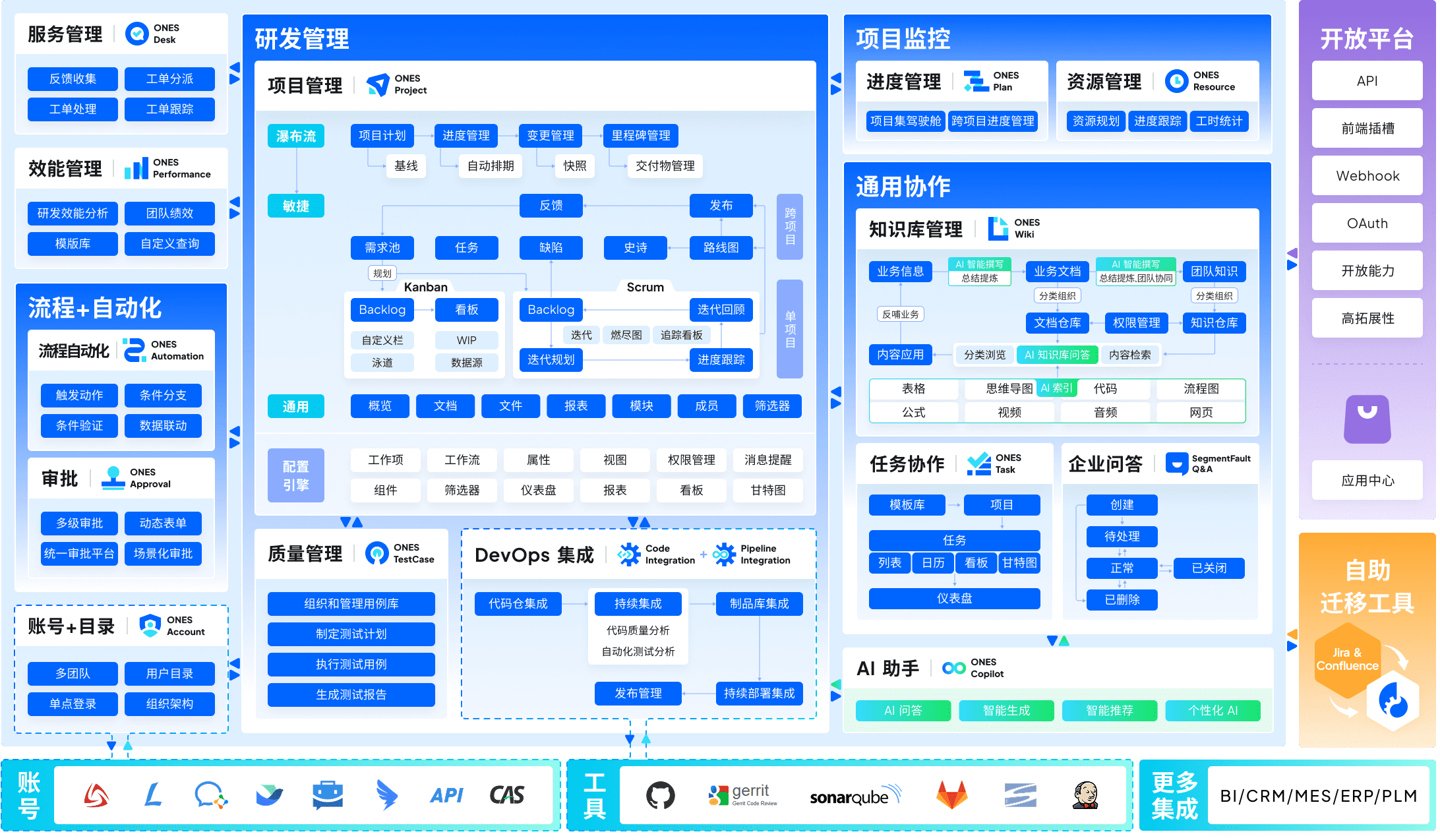
ONES is an enterprise-level research and development management platform. Its architecture unifies project coordination, requirement definition, knowledge repositories, quality assurance, continuous integration pipelines, and source control within a single operational environment. This consolidation eliminates the fragmentation that typically forces small businesses to maintain separate subscriptions for tracking, documentation, and delivery oversight.
The platform was selected for this review because it addresses a specific failure pattern: phase dependencies collapsing when requirements, tasks, and approvals reside in disconnected systems. ONES enforces sequential workflow integrity through native milestone gating, integrated requirement baselining, and permission structures designed for multi-layered organizational hierarchies.
Core operational strengths:
- Phase-locking mechanism: Downstream activities remain inaccessible until upstream approvals are formally closed, preventing premature execution.
- Requirement immutability: Baseline specifications undergo structured review and lock before development commencement, constraining scope expansion.
- Executive visibility: Real-time dashboards surface completion percentages and risk indicators without manual report compilation.
- Context preservation: Technical specifications and validation protocols maintain persistent links to associated work items, reducing information loss across handoffs.
- Deployment flexibility: Cloud, private cloud, and fully on-premise installations accommodate data sovereignty requirements.
For small businesses delivering software under fixed-price arrangements, ONES provides governance depth typically associated with larger enterprise platforms without mandating extensive plugin architectures.
Smartsheet
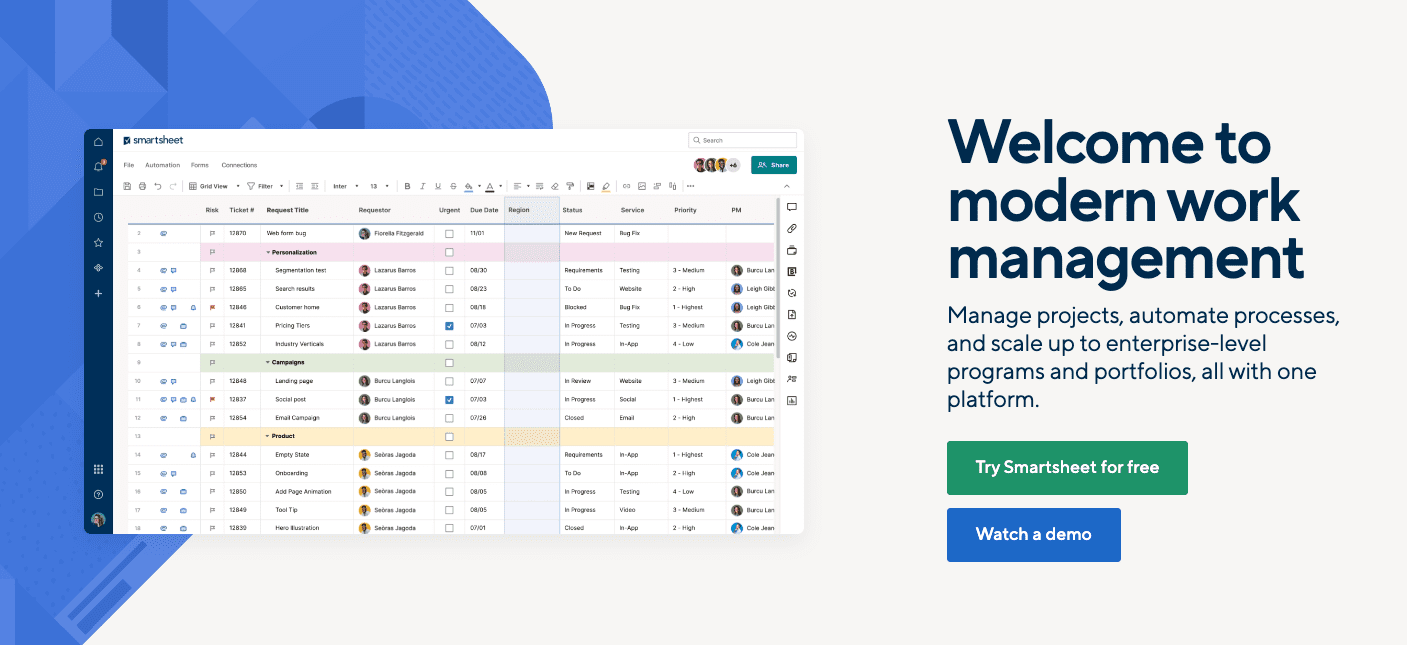
Smartsheet bridges familiar spreadsheet interaction patterns with formal project management structure. Teams accustomed to Excel-based planning can transition without abandoning grid-based data entry, while gaining automated Gantt generation and cross-sheet dependency linking.
The platform excels when project managers need to preserve existing formula logic or reporting formats developed in spreadsheet environments. Its limitation emerges in strict phase enforcement: dependencies can be configured but lack the hard gating found in development-focused alternatives. For construction, marketing campaigns, or event planning where schedule visibility matters more than rigorous access control, this tradeoff is acceptable.
Asana
Asana reduces waterfall coordination to its essential elements: milestones, task sequences, and deadline accountability. The interface minimizes cognitive load, making it suitable for teams without dedicated project management specialists.
Dependency mapping exists but operates as guidance rather than enforcement. This makes Asana appropriate for internal initiatives with collaborative rather than contractual deadlines. The timeline view provides sufficient phase visualization for stakeholder communication, though baseline preservation and variance reporting require manual workarounds.
Monday.com
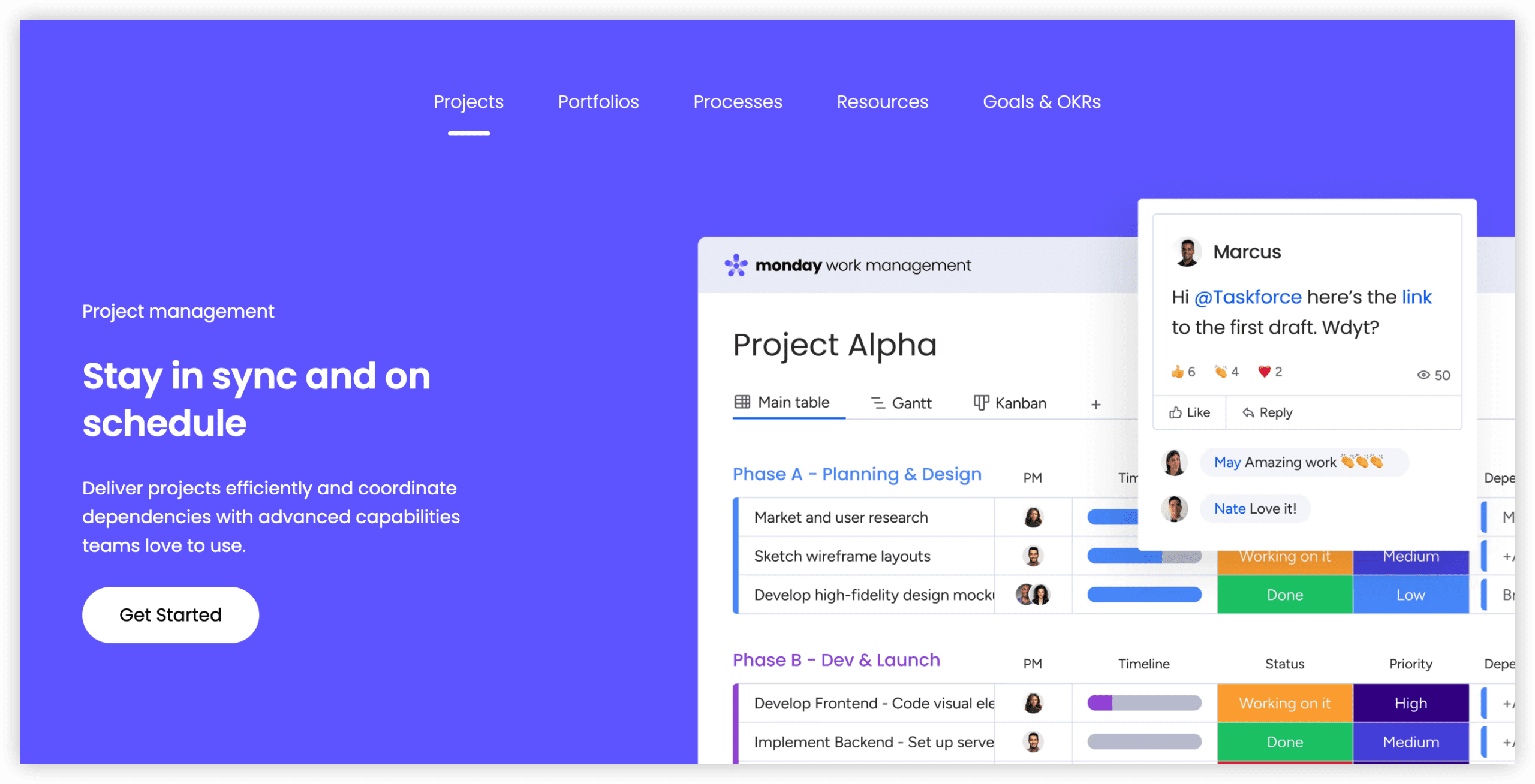
Monday.com translates project status into immediately comprehensible visual states. Color-coded columns and progress indicators enable rapid comprehension without drilling into detailed schedules.
The platform’s strength lies in stakeholder communication rather than execution control. Phase transitions can be visually tracked, but the system does not inherently prevent advancement before prerequisite completion. For client-facing projects where perception management parallels actual delivery, this visual clarity proves valuable.
Wrike
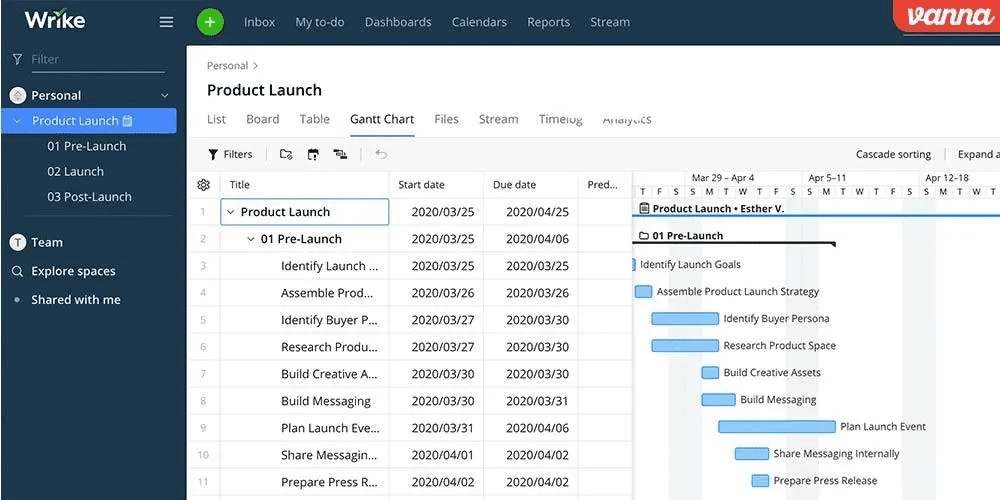
Wrike extends beyond single-project management to address resource contention across multiple concurrent waterfalls. Its workload charts reveal overallocation before it triggers deadline slippage.
The complexity of this capability introduces corresponding configuration demands. Small businesses with straightforward sequential projects may find the learning curve disproportionate to benefit. Organizations running three or more simultaneous fixed-scope engagements with shared personnel will extract meaningful value from the portfolio-level visibility.
ClickUp
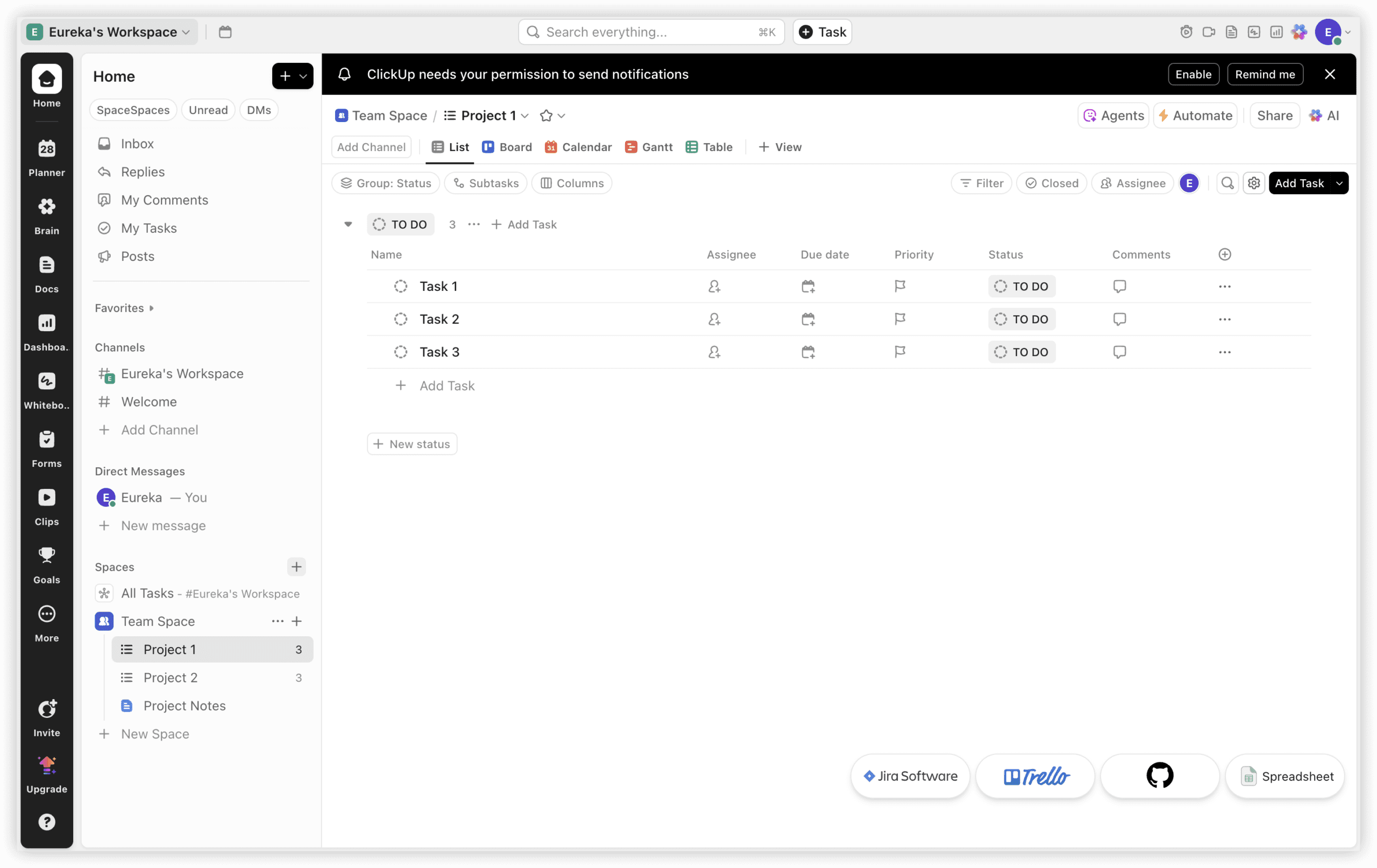
ClickUp offers granular customization at price points accessible to small businesses. Hierarchy depth — from portfolios through projects to individual tasks — can be extended or collapsed according to operational needs.
This flexibility introduces configuration risk. Without disciplined template standardization, each project manager may construct incompatible structures, fragmenting organizational learning. The platform rewards teams willing to invest upfront design effort in exchange for long-term adaptability.
GanttPRO
GanttPRO dispenses with extraneous functionality to focus exclusively on schedule optimization. Critical path calculation, resource leveling, and baseline comparison operate with precision unavailable in generalist platforms.
The narrow focus becomes constraining when projects require integrated document management, requirement traceability, or quality assurance workflows. For scheduling specialists managing timelines as discrete deliverables, the specialization is advantageous. For teams seeking unified project environments, supplementary tools become necessary.
Selection Guidance
Matching platform to operational context requires honest assessment of three factors: project complexity, team structure, and compliance posture.
Consider ONES when delivering software under contractual terms with data residency requirements or when requirement traceability audits are anticipated. The integrated pipeline and test management capabilities reduce toolchain fragmentation for development-centric organizations.
Consider Smartsheet when existing processes rely heavily on spreadsheet formulas and the transition barrier to new interfaces must be minimized.
Consider Asana when team project management maturity is emerging and sophisticated enforcement mechanisms would be underutilized.
Consider Monday.com when external stakeholder communication consumes disproportionate effort and visual status reporting would reduce inquiry volume.
Consider Wrike when individual contributors span multiple projects simultaneously and resource conflicts routinely threaten deadlines.
Consider ClickUp when budget constraints are severe but operational requirements are too specific for rigid out-of-box configurations.
Consider GanttPRO when scheduling analysis constitutes the primary project management responsibility and other functions are handled by separate systems.
Concluding Assessment
No single platform universally dominates waterfall management for small business. The optimal choice depends on whether the primary pain point lies in execution governance, stakeholder communication, resource optimization, or schedule precision.
ONES distinguishes itself through native integration depth and deployment flexibility for development organizations. Smartsheet and Asana lower adoption barriers for teams with established workflow patterns. Monday.com and Wrike address visibility and resource challenges respectively. ClickUp and GanttPRO occupy opposite ends of the customization-specialization spectrum.
For 2026, small businesses should prioritize tools that enforce their chosen methodology rather than merely accommodate it. The cost of permissive systems manifests in missed dependencies, unrecognized scope expansion, and retrospective schedule recovery efforts that exceed any subscription differential.
Frequently Asked Questions
What distinguishes ONES from generalist project management platforms?
ONES integrates requirements management, test execution, continuous integration, and knowledge repositories natively rather than through external connectors. This architecture eliminates synchronization failures that commonly disrupt phase-gated software delivery. The availability of on-premise deployment further differentiates it for organizations with data localization obligations.
Are these platforms financially accessible to small business budgets?
All seven reviewed tools offer free tiers or entry-level pricing below $11 per user monthly. The relevant calculation includes not only subscription costs but also administrative overhead, integration maintenance, and productivity loss from inadequate methodology enforcement. A lower subscription with higher failure rates often proves more expensive than comprehensive alternatives.
Is local infrastructure necessary for effective waterfall management?
Cloud hosting suffices for most operational scenarios. On-premise or private cloud deployment becomes relevant when handling regulated data, operating under specific jurisdictional requirements, or maintaining air-gapped development environments. ONES provides this option; most competitors do not.
How does waterfall methodology differ from agile approaches for small teams?
Waterfall prescribes complete phase completion before subsequent initiation, with requirements fixed at project outset. Agile embraces iterative refinement with flexible scope. Small teams under contractual obligation or hardware delivery constraints typically benefit from waterfall’s predictability, while product development with evolving market fit may favor agile alternatives. Tool selection should reflect this fundamental operational choice rather than impose methodology against organizational reality.