400-188-1518
7 Best Requirements Management Software in 2026: Enterprise Guide
7 Leading Requirements Management Platforms for 2026
This guide examines seven requirements management solutions positioned to serve engineering organisations in 2026. The platforms covered are:
- ONES — Enterprise-grade integrated R&D management
- Jama Connect® — Live traceability and risk-driven development
- Visure Requirements — Compliance-focused regulatory alignment
- Modern Requirements (Azure DevOps) — Microsoft-native extension
- Cognition — Risk and compliance-driven engineering
- IBM Engineering Requirements Management DOORS Next — Large-scale systems engineering
- Reqtify — Embedded systems traceability
How requirements management has become a strategic discipline
Engineering organisations have moved past treating requirements as static documents filed at project initiation. Contemporary product development demands that requirements function as dynamic assets—continuously validated, traced across lifecycle stages, and connected to risk frameworks and test verification.
Several structural shifts drive this evolution. Regulatory frameworks governing safety-critical industries have tightened considerably. Distributed engineering teams require synchronous alignment mechanisms. Parallel development across mechanical, electrical, and software domains creates interdependency complexity that spreadsheets cannot represent.
The consequence is clear: generic productivity tools no longer suffice. Purpose-built requirements management platforms have become foundational infrastructure for organisations seeking controlled, auditable, and efficient product delivery.
Essential capabilities for requirements management evaluation
Selecting an appropriate platform demands assessment across multiple functional dimensions. Based on observed implementation patterns, organisations should prioritise the following criteria:
Unified system of record
The platform must establish a definitive source for current requirements, revision history, and stakeholder accountability. Fragmented information repositories generate alignment failures and compliance gaps.
Comprehensive traceability architecture
Bidirectional linking between requirements, validation procedures, and risk assessments enables impact analysis and reduces rework exposure. For regulated sectors, this capability carries mandatory compliance weight.
Collaborative workflow orchestration
Review cycles, approval gates, and cross-functional input mechanisms should operate without creating process bottlenecks. Requirements refinement typically involves product management, engineering, quality assurance, and regulatory specialists.
Ecosystem integration depth
The solution should connect natively with CI/CD infrastructure, issue tracking systems, test management tools, and version control platforms. Disconnected toolchains impose manual overhead and synchronisation risk.
Regulatory standard alignment
Industry-specific compliance support varies significantly. Medical device manufacturers require ISO 13485 alignment; automotive suppliers need ISO 26262 coverage; aerospace developers depend on DO-178C or ARP4754A conformance.
Scalability and configurability
The architecture must accommodate growth from discrete projects to enterprise portfolio scale without performance degradation or operational restructuring.
Operational intelligence
Dashboards and reporting mechanisms should translate activity data into measurable indicators—coverage metrics, traceability matrix completeness, and risk exposure assessments.
Detailed platform analysis
ONES — Integrated enterprise R&D management
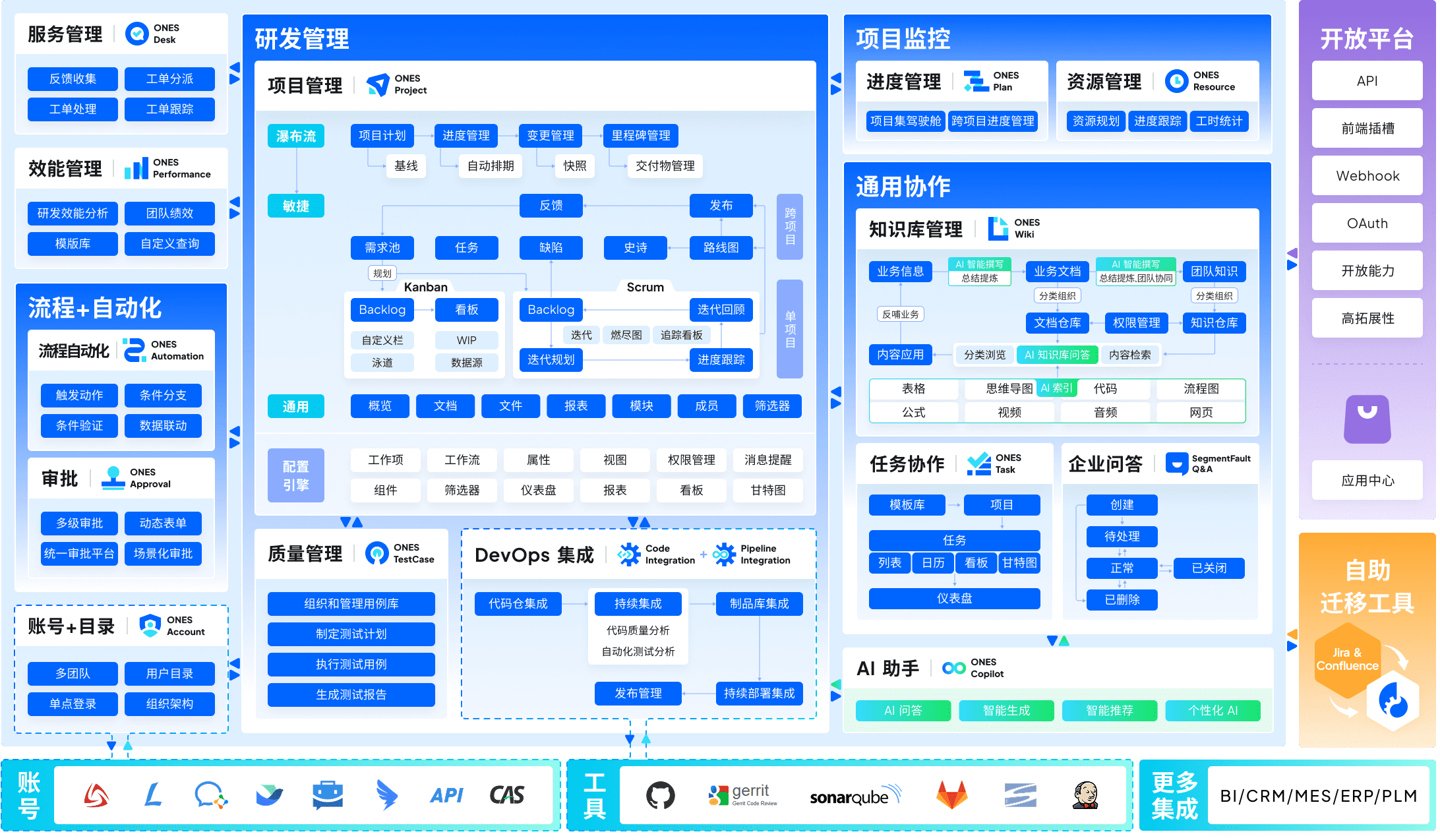
ONES occupies a distinctive position as a comprehensive enterprise platform engineered specifically for research and development operations at organisational scale. Rather than isolating requirements management as a standalone function, ONES embeds it within a unified architecture spanning project coordination, demand planning, knowledge repositories, test governance, pipeline automation, and code management.
This integration philosophy directly addresses a persistent challenge in large engineering organisations: tool fragmentation. When requirements exist in separate systems from tests, documentation, and deployment pipelines, traceability becomes an exercise in manual reconciliation. ONES eliminates these seams by design.
The platform demonstrates particular strength in complex organisational contexts. Multi-layered permission models support sophisticated governance structures. Cross-functional collaboration frameworks accommodate distributed teams with divergent process maturity. Workflow configuration flexibility allows adaptation to established operational patterns rather than forcing standardisation.
A defining characteristic of ONES is its emphasis on engineering effectiveness measurement. The platform surfaces quantitative indicators that enable leadership to diagnose delivery bottlenecks, assess quality trends, and direct improvement investments with empirical foundation rather than intuition.
Primary capabilities
- Unified lifecycle coverage integrating requirements, projects, testing, knowledge, and DevOps functions
- Enterprise-grade permission architecture and cross-team coordination mechanisms
- Data-driven effectiveness measurement supporting continuous delivery improvement
- Adaptable workflow configuration preserving existing operational investments
- Reduced integration burden through native functional cohesion
Considerations
- Organisational scale and complexity necessary to realise full integration value
- Implementation scope typically exceeds point-solution deployment timelines
Jama Connect® — Live traceability and risk-driven requirements management
Jama Connect® targets organisations developing products where operational failure carries severe consequences. The platform constructs an integrated environment for requirements, risk, and validation management serving as the authoritative record for multidisciplinary engineering collectives.
The distinguishing architectural element is Live Traceability™—a mechanism providing continuous visibility into requirement relationships with tests, risks, and implementation artifacts. This represents active monitoring rather than passive documentation, surfacing divergence before it compounds into expensive remediation.
Intelligent augmentation through Jama Connect Advisor™ applies automated analysis to requirement quality assessment and risk identification. This reduces manual inspection burden while maintaining conformance with recognised standards including INCOSE guidelines and EARS notation.
Primary capabilities
- Lifecycle-spanning requirements, traceability, and compliance management
- Real-time tracking of requirement-test-risk relationships
- AI-assisted quality improvement and automated risk detection
- Extensive integration adaptability across development and verification toolchains
- Enterprise scalability with proven large-team deployment history
- Pre-configured templates for medical device, automotive, aerospace, and software domains
- Flexible deployment with SOC 2 Type 2 certification and defined recovery commitments
Considerations
- Premium positioning relative to constrained-feature alternatives
- Cost-sensitive evaluations may default to conventional document tools
User assessments
- G2: 4.3/5 (180+ evaluations)
- Capterra: 4.3/5 (50+ evaluations)
Visure Requirements — Compliance-focused requirements management
Visure constructs its platform identity around regulatory conformance and traceability rigour. The architecture reflects intentional design for organisations where audit preparedness and standard alignment constitute primary operational constraints.
Template libraries accelerate implementation for organisations with established compliance obligations. These pre-configurations address standards prevalent in aerospace, defense, automotive, and medical technology sectors—domains where regulatory fluency directly determines market access.
Primary capabilities
- Requirements governance with robust traceability and compliance-oriented workflows
- Domain-specific templates for regulated industry verticals
- ALM platform and development tool connectivity including Jira integration
- Risk management and model-based systems engineering support
- Configurable process adaptation to organisational requirements
- Regulatory-aligned documentation and reporting generation
Considerations
- Smaller user community and ecosystem footprint relative to established leaders
- Scalability constraints for programmes with exceptionally large data volumes
- Interface refinement below market-leading benchmarks
- Integration breadth more restricted than comprehensive platforms
User assessments
- G2: 4.1/5 (25+ evaluations)
- Capterra: 4.9/5 (10+ evaluations)
Modern Requirements (Azure DevOps) — Microsoft-native requirements extension
Modern Requirements operates as an embedded extension within Azure DevOps, offering particular value for organisations with substantial Microsoft infrastructure investment. The implementation model adds requirements management depth without requiring migration to independent platforms or retraining teams on unfamiliar interfaces.
The integration preserves existing Azure DevOps workflows while supplementing them with requirements traceability, collaborative review, and work item linkage. This co-location with code repositories, build pipelines, and release management creates operational continuity.
Primary capabilities
- Native requirements management within Azure DevOps environment
- Traceability and collaboration through familiar Azure DevOps interaction patterns
- Agile and DevOps practice support with Azure Boards and Pipelines connectivity
- Unified requirements-code-build-release management
- Cohesive Microsoft tool ecosystem experience
- Moderate-complexity project adequacy
Considerations
- Functional boundaries defined by Azure DevOps ecosystem perimeter
- Compliance-intensive applications require substantial customisation
- Feature depth below dedicated requirements management specialists
- Advanced traceability, risk governance, and regulatory workflow limitations
- Scalability thresholds for very large or complex programmes
User assessments
- G2: 3.9/5 (40+ evaluations)
- Capterra: 4.1/5 (25+ evaluations)
Cognition — Risk and compliance-driven engineering
Cognition directs its platform development toward regulated sectors with formal risk management obligations. The architecture serves engineering organisations requiring simultaneous management of requirements, structured risk assessments, and regulatory documentation.
Medical technology and life sciences represent primary addressable markets, though applicability extends to other heavily regulated domains. Model-based systems engineering capabilities support organisations advancing systems-level design maturity.
Primary capabilities
- Vertical focus on compliance-intensive industries including medical devices and life sciences
- Formal risk assessment tracking integrated with requirements management
- Model-based systems engineering support for systems-level architecture
- Regulatory standard-aligned workflow design
- Engineering and development tool integration
- Regulatory submission-oriented documentation and reporting
Considerations
- Reduced market presence and community scale relative to category leaders
- Limited integration ecosystem necessitating supplementary ALM tooling
- Interface sophistication below competitive benchmarks
IBM Engineering Requirements Management DOORS Next — Large-scale systems engineering
IBM Engineering Requirements Management DOORS Next represents the evolutionary successor to a long-established systems engineering standard. The platform addresses programmes characterised by extreme scale, extended duration, and multi-organisational coordination complexity.
The architecture supports requirements management across aerospace, defense, automotive, and industrial domains where product complexity demands rigorous configuration control and baseline management. Change impact analysis capabilities enable assessment of modification scope across interconnected requirement sets before implementation commitment.
Primary capabilities
- Proven scalability for programmes with thousands to millions of requirements
- Sophisticated change management with comprehensive impact analysis
- Multi-level configuration and baseline control
- Integration with broader IBM Engineering lifecycle suite
- Industry-standard compliance support for safety-critical domains
- Established ecosystem of implementation partners and training resources
Considerations
- Implementation complexity and resource requirements substantial
- Licensing and operational cost positioned at premium tier
- User experience reflects legacy architecture evolution
- Agile adaptation requires deliberate configuration effort
Reqtify — Embedded systems traceability
Reqtify specialises in traceability automation for embedded systems development, with particular strength in automotive, aerospace, and industrial automation contexts. The platform emphasises extraction and linkage of requirements from heterogeneous document formats and engineering tools.
Rather than functioning as a standalone requirements authoring environment, Reqtify operates as a traceability intelligence layer across existing documentation repositories and development artifacts. This positioning suits organisations with established document practices seeking to augment them with automated relationship detection and coverage analysis.
Primary capabilities
- Automated requirement extraction from diverse document formats
- Cross-tool traceability with extensive third-party integration
- Coverage analysis and gap identification
- Impact assessment for change propagation
- Compliance reporting for automotive (ISO 26262, ASPICE) and aerospace standards
- Non-intrusive deployment preserving existing tool investments
Considerations
- Supplementary to rather than replacement for requirements authoring tools
- Specialised positioning limits broader project management applicability
- Configuration expertise required for optimal extraction accuracy
Platform selection guidance
Appropriate platform selection depends on organisational context variables including team distribution, regulatory exposure, existing infrastructure, and programme scale.
Organisations seeking unified R&D management with integrated requirements, project coordination, testing, and delivery pipeline governance should evaluate ONES as the foundational platform. Its enterprise orientation suits complex organisational structures with cross-team coordination demands.
Teams operating in safety-critical domains with live traceability as a core requirement should assess Jama Connect®. The real-time relationship monitoring and AI-assisted quality mechanisms address programmes where early divergence detection carries substantial economic value.
Compliance-prioritised implementations with established regulatory frameworks may find Visure Requirements accelerates time-to-conformance through purpose-built templates.
Microsoft-committed organisations can extend Azure DevOps with Modern Requirements when requirements complexity remains moderate and ecosystem continuity outweighs specialised depth.
Engineering-heavy regulated environments with formal risk assessment integration needs should examine Cognition.
Programmes of exceptional scale with extended supply chain coordination may require IBM DOORS Next despite implementation investment.
Embedded systems developers with heterogeneous tool environments and traceability automation priorities should consider Reqtify as a non-disruptive enhancement layer.
Frequently asked questions
What distinguishes requirements management platforms from general project management tools?
Requirements management platforms provide specialised capabilities for bidirectional traceability, compliance documentation, and requirement-test-risk relationship management that general project management tools do not natively support. While tools like Jira or Asana manage tasks and workflows effectively, they lack the structured traceability matrices, regulatory alignment features, and lifecycle coverage analysis that complex engineering programmes require.
How should organisations approach migration from document-based requirements management?
Migration success depends on phased implementation with explicit traceability objectives. Organisations should begin by identifying compliance-critical requirement sets for initial platform transition, establish template structures that mirror existing document organisation, and validate extraction accuracy before expanding scope. Parallel operation during transition reduces operational risk.
What integration architecture should enterprises prioritise?
Priority integration points include: bidirectional synchronisation with issue tracking systems for requirement-to-implementation traceability; test management connectivity for coverage verification; and CI/CD pipeline linkage for deployment requirement validation. API robustness and webhook support determine integration maintainability.
How is AI capability evolving in requirements management platforms?
Current AI applications focus on requirement quality assessment—detecting ambiguity, inconsistency, and incompleteness—and automated risk identification based on requirement content analysis. Emerging directions include natural language generation for requirement refinement suggestions and predictive analytics for delivery risk based on requirement volatility patterns.
What total cost factors should evaluation include beyond licensing?
Comprehensive cost assessment must incorporate: implementation and configuration services; integration development and maintenance; training and change management; ongoing administration overhead; and potential custom development for specialised compliance or workflow needs. Cloud deployment models shift cost structure from capital to operational expenditure but may increase long-term total cost for stable, long-duration programmes.