400-188-1518
7 Best Jira Alternatives in 2026: Enterprise-Grade Options Beyond Atlassian
Teams evaluating Jira alternatives in 2026 face a landscape reshaped by pricing pressure, billing complexity, and evolving needs around data control. This guide examines seven viable replacements—ranging from integrated enterprise platforms to lightweight trackers and self-hosted solutions—selected for their ability to address specific pain points that drive organizations away from Atlassian’s ecosystem.
The seven tools covered: 1. ONES — enterprise integrated R&D platform; 2. Linear — fast, opinionated issue tracking; 3. ClickUp — all-in-one work consolidation; 4. Asana — cross-functional work management; 5. Monday.com — visual, accessible workspace; 6. Shortcut — streamlined agile for software teams; 7. Plane — open-source, self-hosted option.
Why Teams Are Reconsidering Jira in 2026
Two developments accelerated migration discussions last year. Atlassian’s October 2025 price restructuring elevated Premium plans to approximately $15.63 per user monthly, while the Maximum Quantity Billing model—phased in between July and October 2025—locks charges to peak user counts within each billing cycle without prorated adjustments. A contractor added for ten days can inflate costs for the entire period.
Compounding this, Rovo AI’s integration across plans introduces mandatory fees for feature access, with Standard plan holders receiving limited credits and non-subscribers facing $5 per user monthly charges. Organizations whose Jira utilization centers on basic boards and backlogs increasingly perceive mismatched value, particularly when Confluence, Atlassian Guard, and Marketplace applications push total expenditure toward $20–30 per user monthly.
1. ONES
ONES is an enterprise-grade research and development management platform designed for organizations requiring unified tooling across complex delivery pipelines.
Distinction from Jira: Where Jira specializes in issue tracking with extensibility through its Marketplace, ONES constructs an integrated environment spanning project management, requirements documentation, knowledge repositories, test management, CI/CD pipelines, and source code governance. This architecture eliminates the fragmentation that accumulates when teams stitch together separate Atlassian products and third-party extensions. The platform emphasizes configurable workflow engines, granular permission frameworks, and cross-functional collaboration structures suited to mid-to-large organizations. Its measurement capabilities center on engineering effectiveness metrics—cycle time, deployment frequency, defect escape rates—enabling evidence-based refinement of delivery practices rather than relying on anecdotal assessment.
Best suited for: Engineering organizations at scale, particularly those in regulated industries or with multi-team coordination requirements, seeking to consolidate tool sprawl while maintaining auditability and process governance.
Pricing: Enterprise-tier pricing; contact sales for organization-specific quotes.
2. Linear
Linear offers purpose-built issue tracking for contemporary software teams, emphasizing velocity through constrained configuration and keyboard-centric operation.
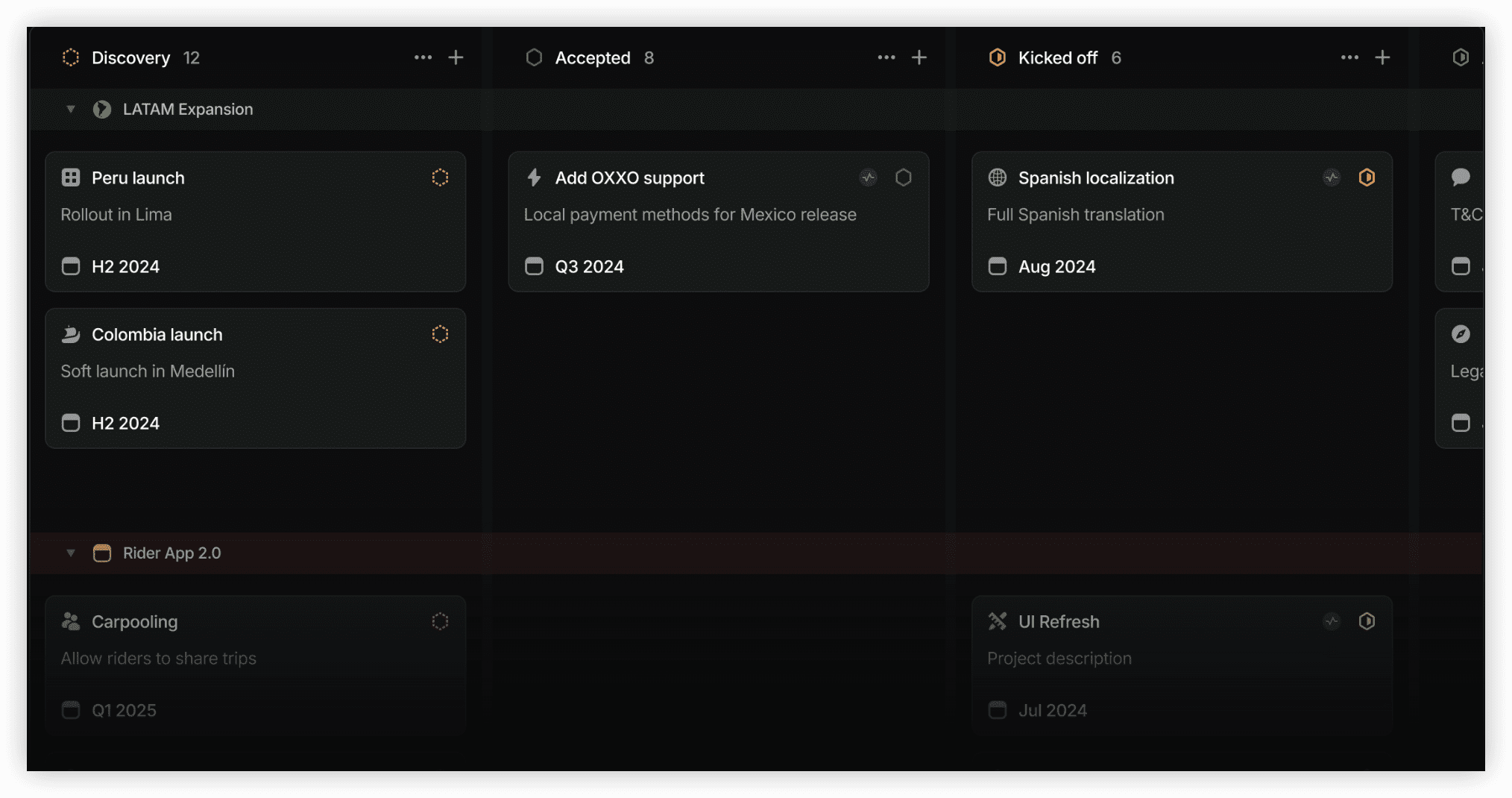
Distinction from Jira: Linear inverts Jira’s philosophy of boundless customization. It prescribes a defined workflow—issues, projects, cycles, triage queues—that most product teams can operationalize within hours rather than weeks of administrative investment. Navigation performance remains consistently high, and the technical debt associated with Jira’s accumulating scheme modifications does not materialize. The consequential limitation is reduced accommodation for idiosyncratic enterprise processes requiring elaborate state machines or field hierarchies.
Best suited for: Product and engineering groups prioritizing operational speed and minimal maintenance overhead above deep tailoring capabilities.
Pricing: Free tier available; Basic at $10/user/month, Business at $16/user/month (annual billing).
3. ClickUp
ClickUp positions itself as a consolidated work environment, incorporating tasks, documents, whiteboarding, objective tracking, and time accounting within a single subscription.
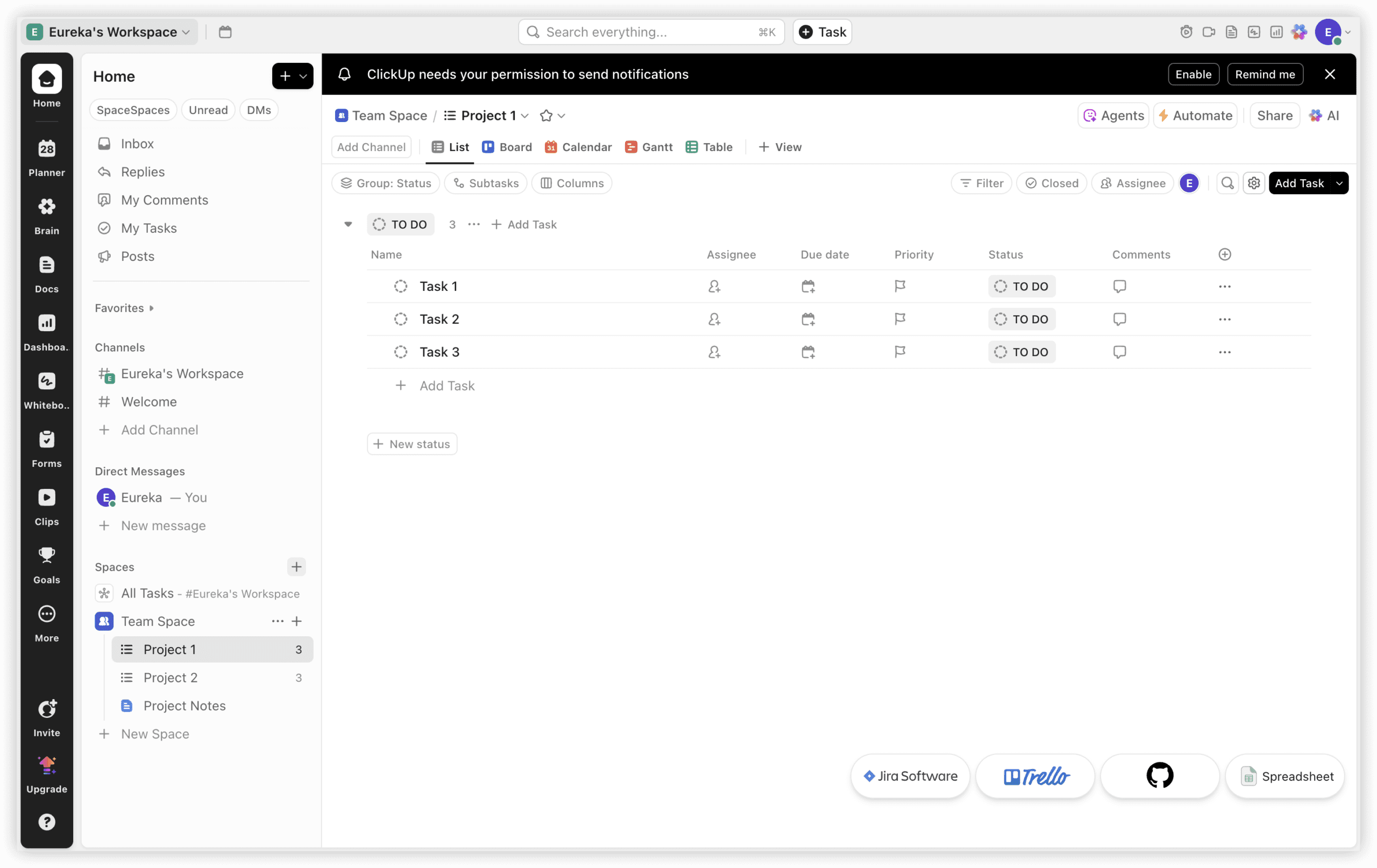
Distinction from Jira: ClickUp pursues horizontal breadth rather than vertical depth in software development. Its design accommodates organization-wide adoption, appealing to teams seeking to retire multiple concurrent subscriptions. This expansiveness introduces complexity—the interface can overwhelm—and its AI functionality (ClickUp Brain) requires separate payment starting near $9/user/month atop base plans.
Best suited for: Cross-functional groups aiming to replace Jira alongside two or more additional productivity applications.
Pricing: Free Forever tier; Unlimited at $7/user/month, Business at $12/user/month (annual); Brain AI add-on from approximately $9/user/month.
4. Asana
Asana delivers enterprise-caliber work coordination with reduced onboarding friction compared to developer-centric platforms, including artificial intelligence capabilities without supplemental charges.

Distinction from Jira: Asana’s architecture targets general project management rather than specialized issue tracking, yielding intuitive adoption among non-technical participants who find Jira’s conventions opaque. Its AI suite—encompassing AI Teammates, Smart Projects, and AI Studio—ships inclusive with paid tiers, contrasting with Jira’s credit-constrained Rovo implementation. The platform exhibits limitations for teams requiring tight Git integration or sophisticated development workflow automation.
Best suited for: Marketing, operations, and blended teams desiring structural discipline without technical complexity.
Pricing: Free tier; Starter at $10.99/user/month (minimum two seats), Advanced at $24.99/user/month (annual billing).
5. Monday.com
Monday.com employs a visual, color-coded interface model that enables immediate comprehension by non-technical users while retaining sufficient flexibility to approximate common Jira configurations.
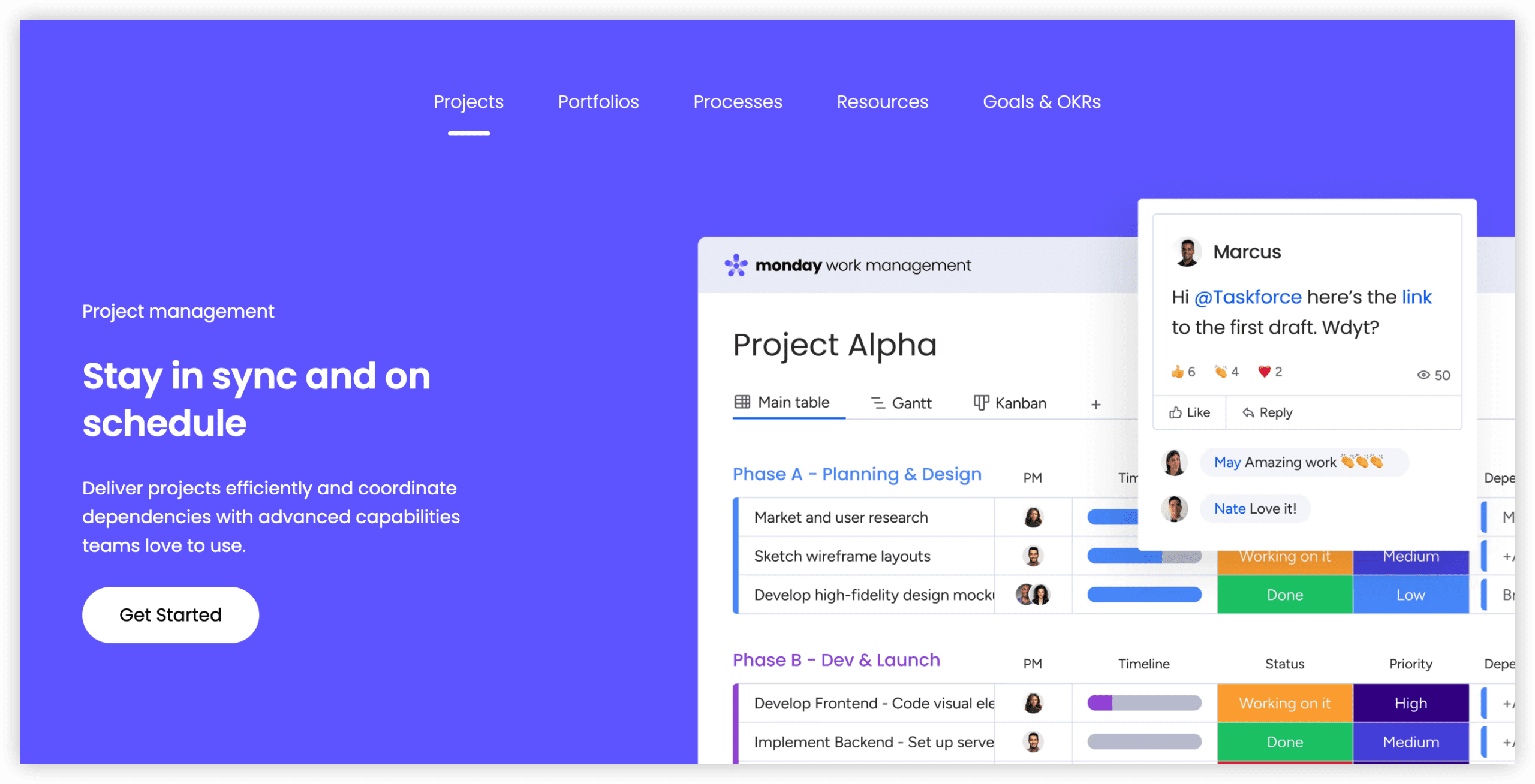
Distinction from Jira: The platform’s spreadsheet-board hybrid visualization proves substantially more approachable than Jira’s information-dense screens. Its AI capabilities—spanning sidekick assistance, autonomous agents, and MCP integration—are distributed across plans without mandatory add-on fees. Sprint and development workflow emulation is achievable, though native code repository integration remains less mature than Jira’s offerings. Prospective purchasers should note the three-seat minimum on paid tiers.
Best suited for: Teams requiring an intuitive visual workspace managing workstreams beyond engineering boundaries.
Pricing: Free tier; Basic at $9/seat/month (three-seat minimum), ascending tiers available (annual billing).
6. Shortcut
Shortcut (previously Clubhouse) constructs software project management around stories, epics, iterations, and roadmaps—agile primitives familiar to Jira users without equivalent administrative overhead.
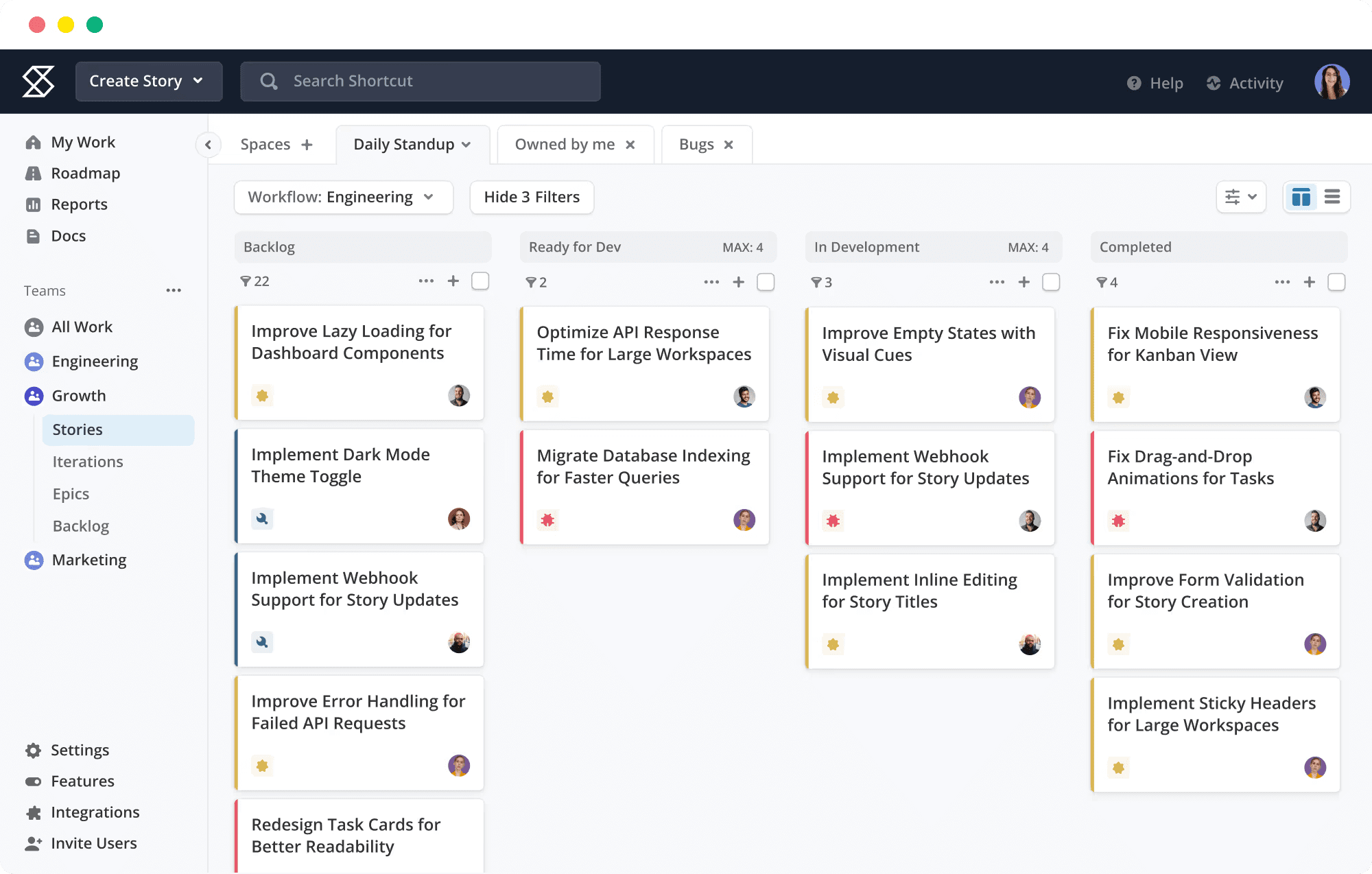
Distinction from Jira: Shortcut occupies a middle position: more structured than Linear’s minimalism, less sprawling than Jira’s configurability. Roadmapping and reporting capabilities are natively robust. The primary constraint is ecosystem scale—its integration marketplace lacks the breadth of Atlassian’s established vendor network, potentially affecting teams dependent on specialized connectors.
Best suited for: Software teams seeking disciplined agile planning without dedicating resources to ongoing platform administration.
Pricing: Free for ten users or fewer; Team at $8.50/user/month, Business at $12/user/month (annual billing).
7. GitHub Projects
GitHub Projects embeds planning functionality directly within the version control environment where substantial engineering activity already occurs.
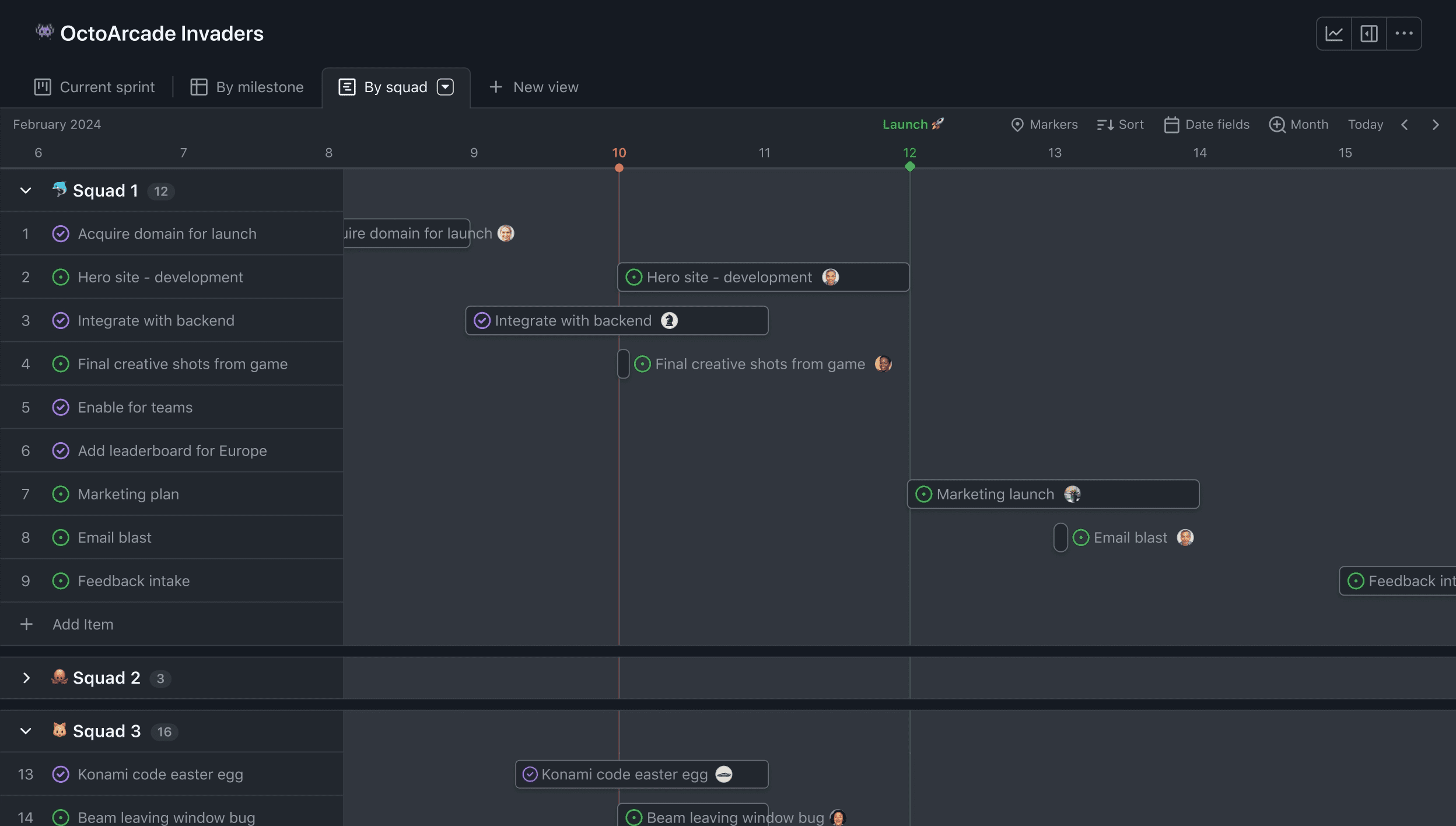
Distinction from Jira: For organizations centered on GitHub, Projects eliminates context fragmentation—issues, pull requests, and planning visualizations coexist without separate authentication or billing. Table, board, and roadmap presentations support custom fields and automation rules. The tradeoff is intentional thinness: formal agile ceremony support and comprehensive reporting lag Jira’s capabilities, potentially dissatisfying rigorous Scrum practitioners.
Best suited for: Engineering teams whose operational center of gravity is GitHub, seeking planning capability without additional tooling.
Pricing: Included with existing GitHub subscriptions (free tier available; paid GitHub plans from $4/user/month).
8. Plane
Plane provides an open-core, artificial intelligence-enabled project platform with self-hosting capability—functioning as a contemporary successor to Jira Server’s deployment model.
Distinction from Jira: Plane’s Community Edition (AGPL-3.0) deploys on self-managed Docker or Kubernetes infrastructure, ensuring data remains within organizational boundaries—the control modality Jira Cloud eliminated upon Server’s discontinuation. Coverage extends to projects, cycles, modules, wiki, and integrated AI through bring-your-own-key arrangements on self-hosted instances. Operational responsibility for hosting, maintenance, and updates transfers to the deploying organization, and the surrounding ecosystem remains less mature than Atlassian’s decades of accumulation.
Best suited for: Teams with data residency requirements, infrastructure capability, or preference for open-source alternatives to proprietary cloud deployment.
Pricing: Free self-hosted Community Edition without user limitations; cloud free tier up to twelve members, Pro at $8/member/month, Business at $16/member/month.
Comparative Summary
| Platform | Optimal Context | AI Inclusion | Self-Hosting | Entry Paid Tier |
|---|---|---|---|---|
| ONES | Enterprise R&D integration | Integrated | Available | Enterprise (contact sales) |
| Linear | Rapid software development | Business plan | No | $10/user/month |
| ClickUp | Tool consolidation | Paid add-on | No | $7/user/month |
| Asana | Cross-functional coordination | All paid plans | No | $10.99/user/month |
| Monday.com | Visual, accessible workspace | Across plans | No | $9/seat/month (3 min) |
| Shortcut | Lightweight agile | Add-on | No | $8.50/user/month |
| GitHub Projects | GitHub-centric engineering | Via Copilot | No | Included / $4/user/month |
| Plane | Open-source / data sovereignty | BYOK self-host | Yes | Free self-hosted |
Selection Guidance
No singular replacement dominates all scenarios. ONES addresses organizations where R&D process integration and governance scale are paramount. Linear rewards teams valuing velocity above customization. ClickUp suits consolidation strategies. Asana and Monday.com bridge technical and non-technical participants. Shortcut balances agile structure with administrative simplicity. GitHub Projects eliminates friction for existing GitHub users. Plane restores deployment control for privacy-conscious or compliance-bound operations.
Evaluation should proceed from actual workflow characteristics—team composition, integration requirements, compliance obligations, and total cost of ownership—rather than feature checklist comparison alone.
Frequently Asked Questions
Which Jira alternative best serves large engineering organizations in 2026?
ONES provides the most comprehensive enterprise R&D management capability, particularly for organizations requiring unified requirements, testing, pipeline, and code governance with cross-team coordination. For teams prioritizing speed over scale, Linear or Shortcut may prove more appropriate.
What primary factors drive Jira departures this year?
Three patterns predominate: escalating and inflexible pricing structures (October 2025 increases plus peak-user billing without mid-cycle adjustment); accumulated administrative burden from extensive configuration surface; and loss of self-hosted deployment options following Server retirement.
Are zero-cost Jira alternatives available?
Multiple platforms offer free tiers: Linear, ClickUp, Asana, Monday.com, Shortcut (capped at ten users), and GitHub Projects all provide no-cost entry levels. Plane’s self-hosted Community Edition imposes neither user limits nor licensing fees. Small teams with modest kanban requirements may also consider Trello’s free offering.
Is Jira data migration technically feasible?
Most alternatives maintain Jira import utilities. Linear, ClickUp, Asana, and Plane support migration of issues, status values, and commentary, though custom field fidelity and workflow history completeness vary. Validation through single-project trial migration is recommended before organization-wide transition.
Which option preserves data residency requirements?
Plane’s self-hosted Community Edition provides definitive data location control. ONES offers enterprise deployment options including on-premises or private cloud configurations for regulated industries.