400-188-1518
8 Best Confluence Alternatives for 2026: Enterprise Wiki Tools Tested by Real Teams
Organizations evaluating knowledge base platforms in 2026 face a fragmented landscape. After testing and reviewing the leading options, we’ve identified eight tools worth serious consideration: ONES, Notion, Coda, Slab, Guru, Tettra, Nuclino, and Slite. Each addresses specific pain points that drive teams away from Atlassian’s Confluence—whether that’s deteriorating editing experiences, unreliable search, or pricing shocks following the Server end-of-life.
Why Teams Are Moving Away From Confluence in 2026
The migration momentum away from Confluence has accelerated beyond typical vendor switching. Five structural problems now dominate user feedback across technical communities and review platforms.
Editor Quality Has Declined
Atlassian’s Cloud transition introduced regressions that veteran users document extensively. Table formatting requires excessive steps. Background color controls malfunction. Numbered headers lost default compatibility with table of contents generation. These aren’t edge cases—they’re daily friction points that compound across large documentation sets.
Search Remains Fundamentally Broken
Exclusion filters function inconsistently. Cross-space content discovery fails regularly. Relevance ranking produces seemingly random results. The community shorthand captures it precisely: finding information in Confluence often proves harder than creating it. The optional AI search add-on has not resolved these core architectural limitations.
Server EOL Triggered Severe Pricing Displacement
Perpetual license holders confront subscription costs of $32,520–$62,640 annually for 500-user Cloud deployments—multiples of their previous expenditure. Data Center support ends March 2029, eliminating the remaining on-premises escape route. Organizations that deferred migration decisions now face urgent procurement timelines.
Rovo AI Generates Resistance Rather Than Value
Atlassian’s AI implementation overlays suggestions and prompts throughout the interface without clear opt-out pathways. The credit-based pricing model—25 credits per user monthly on Standard—throttles meaningful adoption. Developer communities consistently describe the experience as imposed rather than invited.
Platform Complexity Accumulates Without Integration
Acquired products (Loom, Trello, StatusPage) operate as adjacent silos rather than cohesive capabilities. Interface controls relocate between releases without usability improvement. Common tasks require progressively more navigation steps. Long-term administrators report the most confusing operational state in two decades of usage.
The 8 Best Confluence Alternatives in 2026
| Tool | Best For | Starting Price | Free Plan | G2 Rating | AI Search |
|---|---|---|---|---|---|
| ONES | Enterprise R&D teams, complex governance | Custom | Limited trial | Not publicly listed | Integrated analytics + search |
| Notion | All-in-one flexibility, AI features | $10/user/month | Yes (limited) | 4.6/5 | Notion AI (Business+) |
| Coda | Teams with many viewers, few editors | $10/Doc Maker/month | Yes | No public listing | Coda AI (credit-based) |
| Slab | Clean, fast wiki replacement | $6.67/user/month | Yes (10 users) | 4.6/5 | AI Ask (Business+) |
| Guru | Enterprise governance, compliance | Custom ($250+/month) | No | No direct listing | Knowledge Agents (all plans) |
| Tettra | Slack-centric teams, repetitive Q&A | $8/user/month | No | 4.6/5 | Kai AI bot (all plans) |
| Nuclino | Minimal, immediate deployment | $6/user/month | Yes (50 items) | 4.7/5 | Sidekick (Business+) |
| Slite | Self-maintaining knowledge bases | $10/user/month | No (14-day trial) | 4.7/5 | Ask + Agent (all plans) |
1. ONES
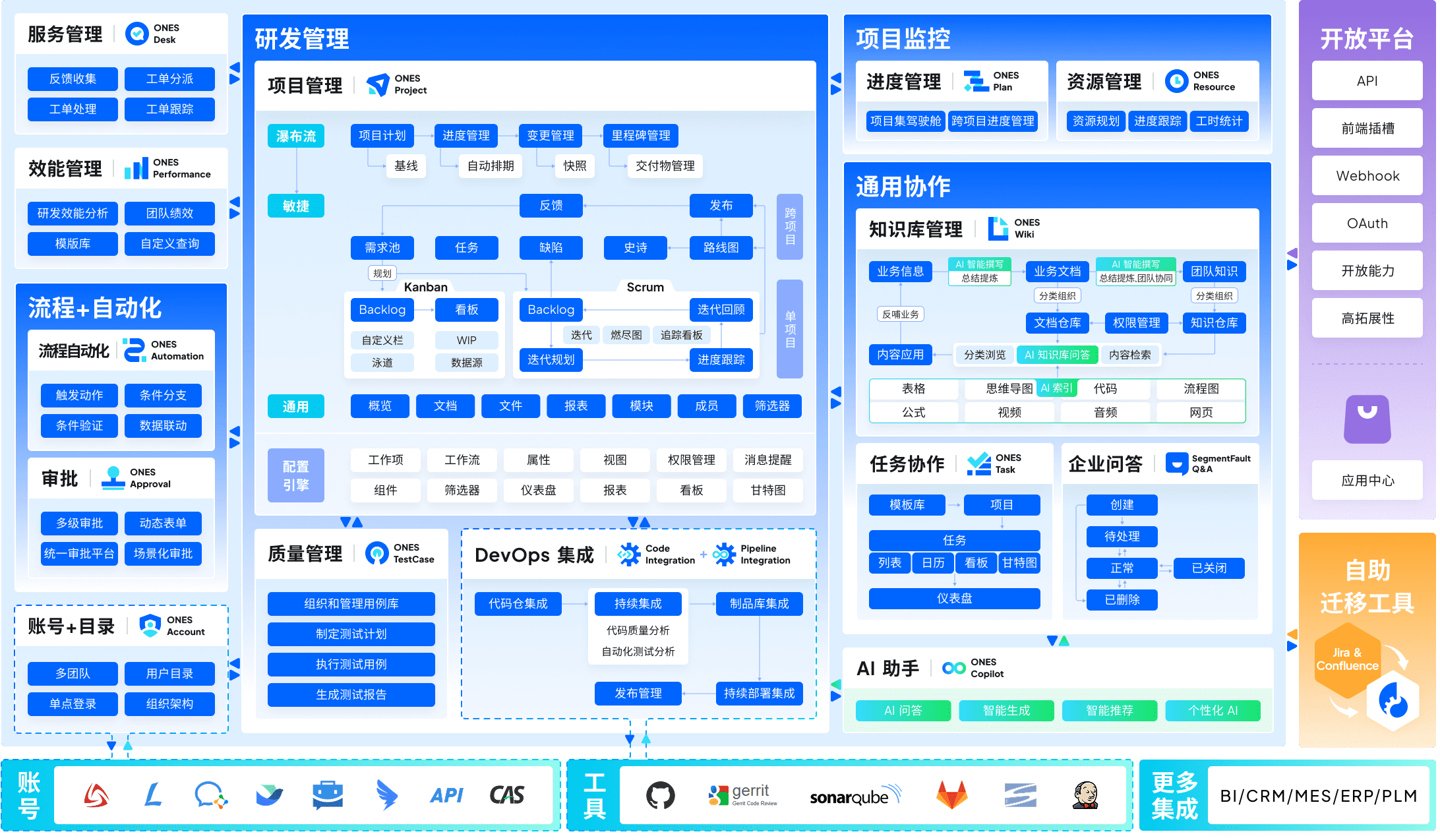
ONES occupies a distinct position in this evaluation: it is not merely a wiki replacement but an enterprise-grade research and development management platform that subsumes knowledge management within a broader delivery ecosystem. For organizations where documentation serves engineering, product, and quality assurance workflows rather than existing as an isolated function, this architectural approach eliminates the tool fragmentation that otherwise accumulates.
The platform integrates project management, requirements traceability, knowledge repositories, test management, CI/CD pipelines, and code management within unified data structures. This consolidation matters particularly for mid-to-large enterprises where handoffs between specialized tools generate invisible coordination overhead. Complex workflow configurations, granular permission models, and cross-team governance capabilities support organizational structures that simpler platforms cannot accommodate.
Where ONES diverges most significantly from Confluence alternatives is its emphasis on engineering effectiveness measurement. The platform surfaces metrics that connect documentation activity to delivery outcomes—enabling data-informed refinement of both processes and resource allocation rather than treating knowledge management as a cost center without performance attribution.
Key capabilities:
- Unified R&D toolchain replacing 5–8 separate point solutions
- Enterprise-scale workflow and permission architecture
- Delivery metrics and quality analytics integrated with content systems
- Designed for 200+ person technical organizations
Considerations:
- Implementation scope exceeds wiki migration alone
- Full value realization requires adoption across multiple R&D functions
- Pricing models suited to enterprise procurement cycles
Assessment: ONES suits organizations where Confluence replacement coincides with broader R&D platform consolidation, particularly those prioritizing measurable delivery improvement over isolated documentation upgrades.
2. Notion
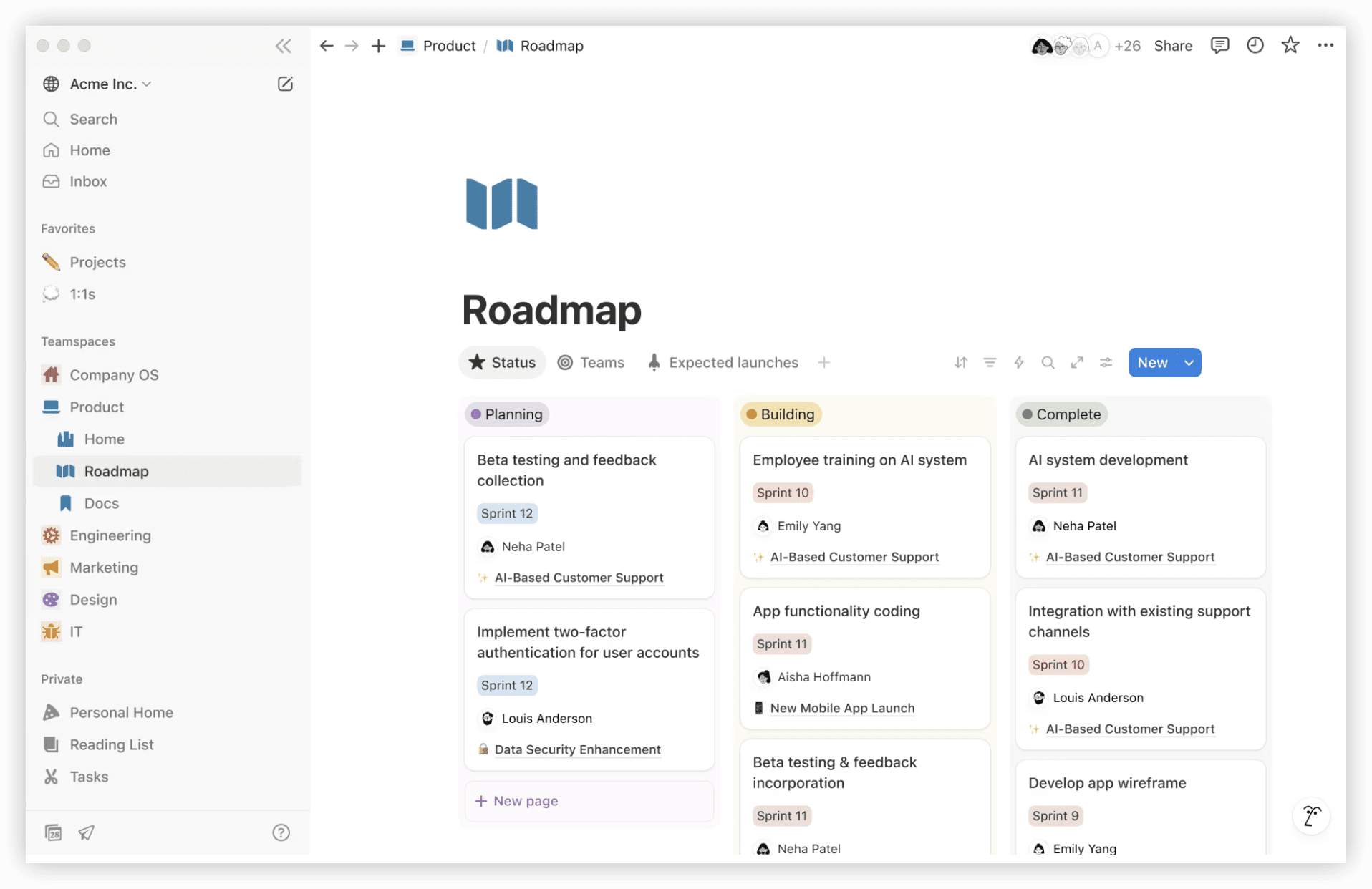
Notion has emerged as the default comprehensive replacement for teams prioritizing editing sophistication and workspace unification. Three consecutive years as G2’s top-rated knowledge base, 100 million-plus users, and adoption by a majority of Fortune 100 companies establish its market position.
The wiki-specific product targets Confluence migrants directly: Synced Blocks replicate macro functionality, Verification badges maintain content currency indicators, and native import utilities reduce transition friction. Comparative evaluations consistently favor Notion’s editor for table manipulation, formatting control, code presentation, and inline commentary.
Differentiating strengths:
- Block-based composition supporting 50-plus content types
- Notion AI (Business/Enterprise): generative writing, cross-tool Enterprise Search, meeting extraction, customizable agents
- Database functionality reducing separate project management dependencies
Limitations:
- Workspace architecture demands dedicated ownership to prevent structural chaos
- Performance degradation reported with extensive inline databases
- Custom agent reliability remains inconsistent per user reports
- Jira integration is search-oriented rather than bidirectionally synchronized
Pricing structure:
- Free: restricted history, limited guests, AI trial only
- Plus: $10/user/month (annual)—unlimited attachments, 30-day revision history
- Business: $20/user/month—complete AI capabilities, SAML SSO
- Enterprise: custom—SCIM, HIPAA compliance, zero data retention
Assessment: Notion fits teams whose Confluence frustration centers on editing experience and who seek integrated AI capabilities. The Business tier bundles substantial functionality but requires structural discipline to avoid implementation waste.
3. Coda
Coda addresses the economic structure of knowledge work rather than merely its interface. Its billing model—charging only “Doc Makers” while editors and viewers access without cost—fundamentally alters cost scaling for organizations with asymmetric participation patterns.
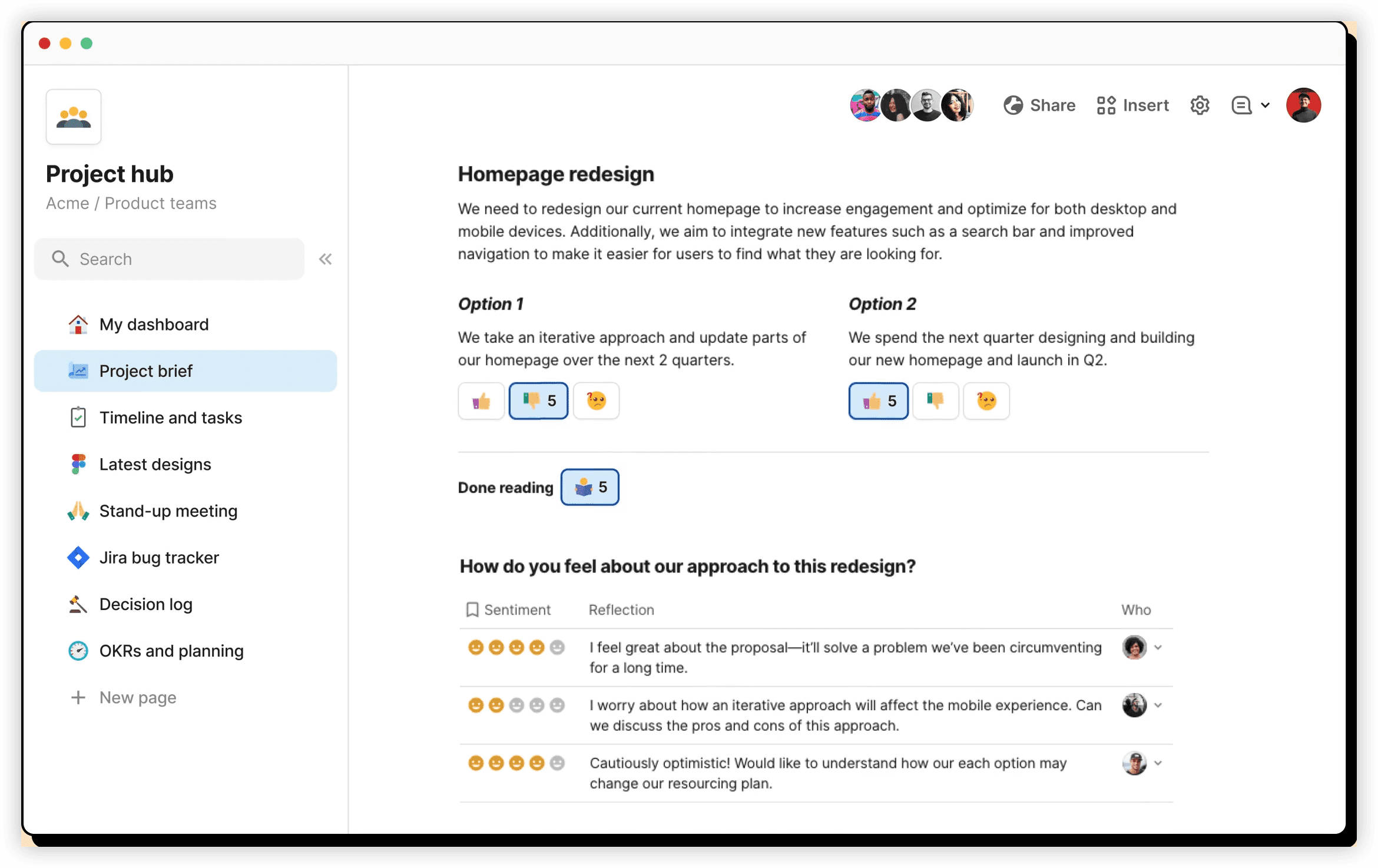
The document-centric architecture embeds tables, kanban views, calendars, and automation logic within pages themselves. A single Coda document can subsume functionality that Confluence would distribute across separate spaces, Jira projects, and spreadsheet files. This integration depth attracted 50,000-plus teams including Figma, The New York Times, and Uber prior to its recent acquisition.
Differentiating strengths:
- Asymmetric pricing: 5 Doc Makers supporting 25 contributors costs $150/month on Team tier
- 600-plus integration Packs connecting external systems
- Formula language exceeding typical spreadsheet capability
- Column-level AI for classification, extraction, and generation across tabular data
Limitations:
- Substantial learning investment required; formula system rewards dedicated study
- Mobile application quality repeatedly cited as inadequate
- Post-acquisition roadmap visibility reduced
- No native cross-tool AI search comparable to Notion Enterprise Search or Slite Ask
Pricing structure:
- Free: Doc Makers only; unlimited editors/viewers
- Pro: $10/Doc Maker/month—30-day history, daily Pack refresh
- Team: $30/Doc Maker/month—unlimited automations, hourly refresh, cross-document synchronization
- Enterprise: custom—SAML SSO, SCIM, SOC 2 Type II, HIPAA, eDiscovery
Assessment: Coda optimizes for teams with complex workflows and heavily skewed creator-to-consumer ratios. The pricing advantage is meaningful at scale; the trade-offs are educational overhead and mobile accessibility constraints.
4. Slab
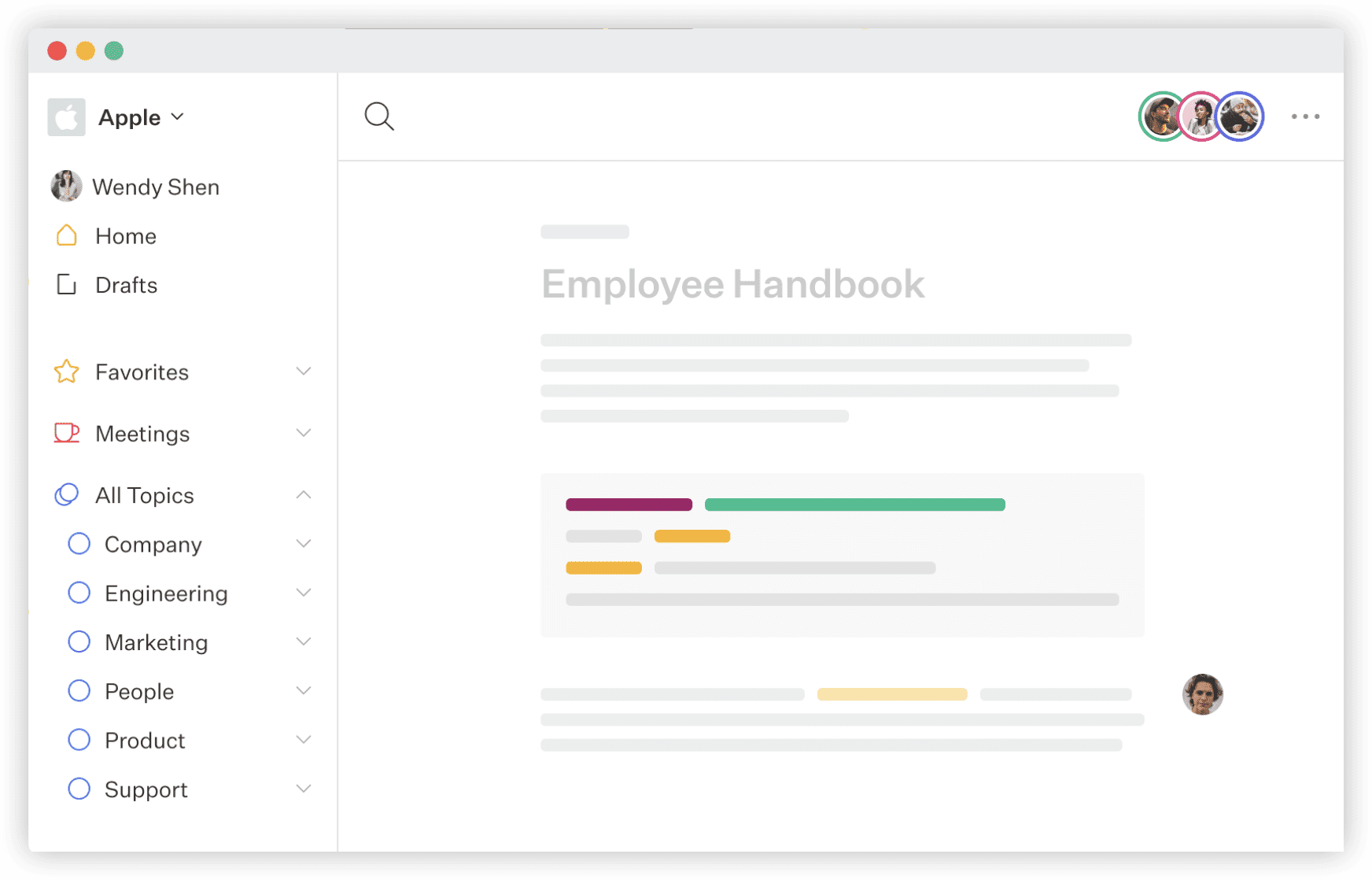
Slab pursues focused excellence in the specific dimensions where Confluence underperforms: editing simplicity, search reliability, and navigational clarity. Its 4.6/5 G2 rating against Confluence’s 4.1/5 reflects consistent outperformance on these fundamentals rather than feature breadth.
Founded in 2016, the platform serves Asana, Ramp, Vox Media, and Glossier among others. Unified Search constitutes its signature capability—executing single queries across Slab documents and connected platforms (Slack, Google Drive, GitHub, Jira) simultaneously. This eliminates the location-guessing burden that degrades Confluence utility.
Differentiating strengths:
- Cross-platform Unified Search
- Topic-based information architecture supplementing hierarchical folders
- Content verification workflows maintaining accuracy confidence
Limitations:
- Feature scope narrower than comprehensive workspace platforms
- Integration ecosystem more constrained than Notion or Coda
- Enterprise governance capabilities less extensive than Guru or ONES
Assessment: Slab suits teams seeking direct Confluence replacement without adjacent workflow consolidation—organizations that want documentation that functions reliably without extensive customization.
5. Guru
Guru targets regulated enterprises where knowledge management intersects with compliance obligations and information governance. The platform emphasizes verified content workflows, access auditing, and administrative control layers that consumer-oriented alternatives minimize.
Knowledge Agents provide AI assistance across all pricing tiers, distinguishing Guru from competitors that restrict AI capabilities to premium levels. The connector framework supports 100-plus integrations, enabling knowledge surfacing without requiring migration from existing repositories.
Differentiating strengths:
- Enterprise-grade verification and governance workflows
- AI capabilities universally available
- Extensive integration ecosystem preserving existing tool investments
Limitations:
- No free tier; minimum entry point $250/month
- Configuration complexity proportional to governance depth
- Smaller teams may find capability overhead disproportionate to needs
Assessment: Guru fits organizations where content verification, access control, and compliance documentation are non-negotiable requirements rather than desirable enhancements.
6. Tettra
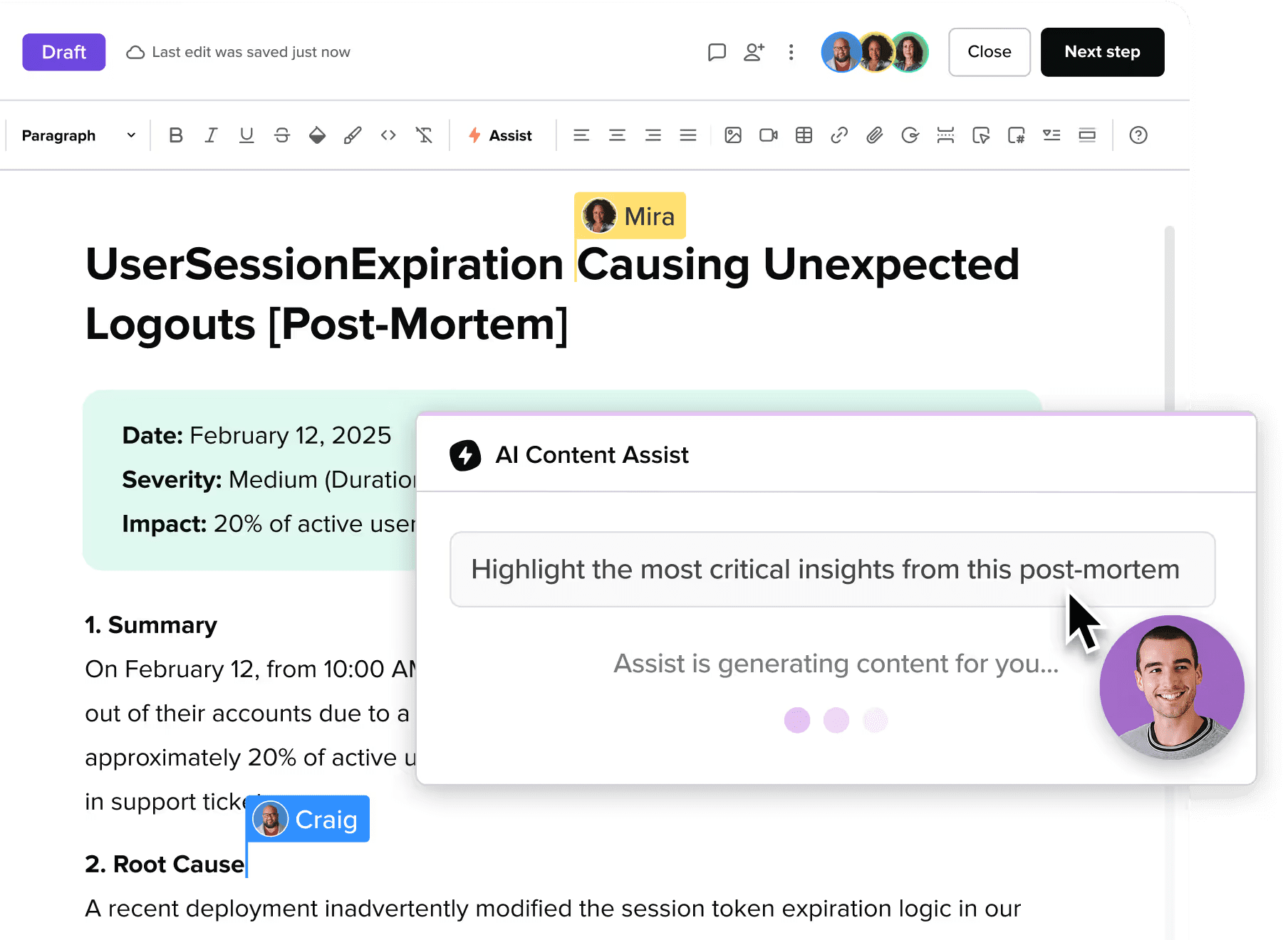
Tettra optimizes for Slack-embedded operations where knowledge requests recur predictably. The platform treats conversational interfaces as primary rather than supplementary—anticipating that team members will query information through chat before navigating to dedicated documentation.
Kai AI bot operates across all plans, automating responses to repeated questions by surfacing relevant documentation without human intervention. This design assumption—that knowledge consumption happens conversationally—differentiates Tettra structurally from page-first alternatives.
Differentiating strengths:
- Native Slack integration as core architecture
- AI bot included without tier restriction
- Question-answering automation reducing expert interruption
Limitations:
- No free plan; 14-day trial only
- Slack dependency limits utility for non-Slack organizations
- Documentation depth capabilities narrower than Notion or Coda
Assessment: Tettra serves teams whose knowledge workflow is already conversational and Slack-dependent, where reducing repeated questioning delivers immediate productivity returns.
7. Nuclino
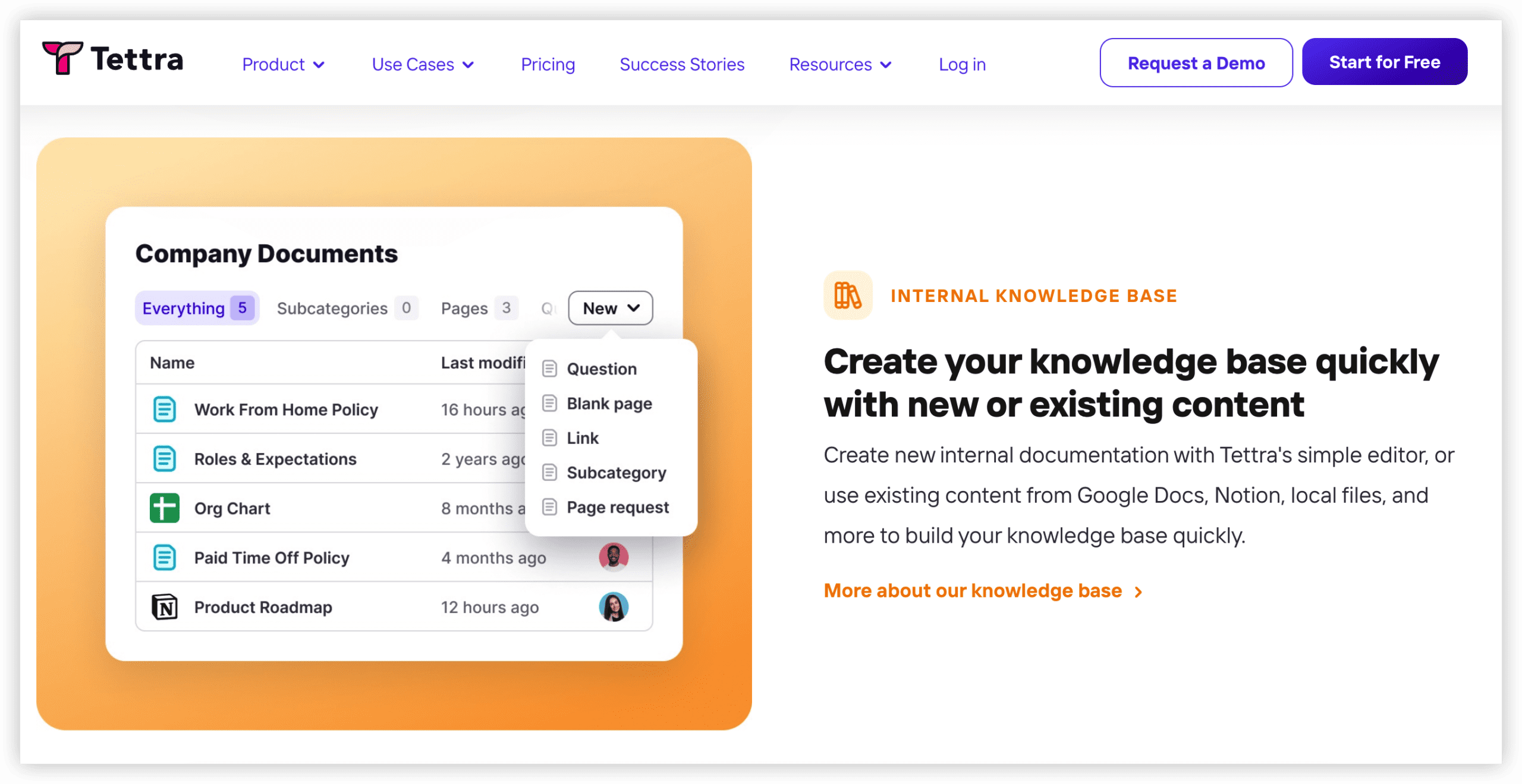
Nuclino prioritizes deployment velocity and operational simplicity. The platform generates a functional team wiki with minimal configuration, targeting organizations where implementation time constitutes a significant selection factor.
The 4.7/5 G2 rating—highest among evaluated tools—reflects satisfaction concentrated among users who value straightforward execution over extensive customization. The 50-item free tier enables substantive evaluation without commitment.
Differentiating strengths:
- Immediate operational readiness
- Minimal administrative overhead
- Strong satisfaction scores relative to complexity
Limitations:
- Feature depth constrained by simplicity mandate
- Integration ecosystem limited
- Enterprise scalability unconfirmed
Assessment: Nuclino suits teams requiring immediate Confluence replacement without implementation investment, accepting capability boundaries in exchange for operational simplicity.
8. Slite
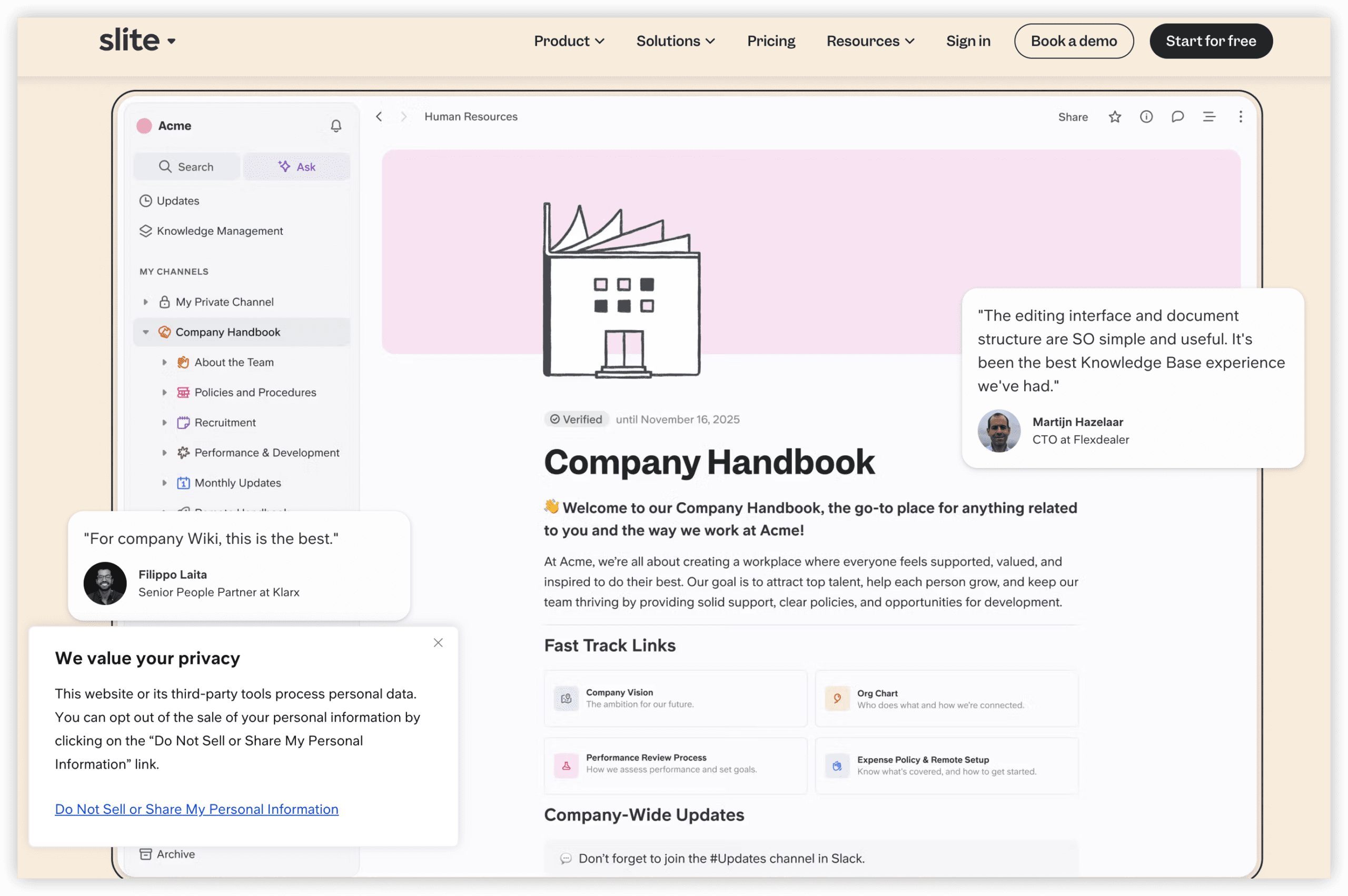
Slite introduces autonomous content maintenance as a distinguishing capability. The platform’s AI layer identifies stale documentation, suggests updates, and answers queries across integrated tools—reducing the manual curation burden that degrades knowledge base quality over time.
Ask and Agent functionality spans all pricing tiers, enabling natural language information retrieval without requiring users to navigate document structures. The self-maintaining architecture addresses the organizational failure mode where documentation creation outpaces maintenance.
Differentiating strengths:
- Automated content freshness management
- Cross-tool AI query processing
- AI capabilities without tier restriction
Limitations:
- No free tier; 14-day trial only
- Smaller user base than Notion or Coda
- Enterprise governance less extensive than Guru or ONES
Assessment: Slite fits organizations where documentation decay has undermined previous knowledge initiatives, prioritizing sustainable maintenance over initial creation capabilities.
Selection Framework
The appropriate Confluence alternative depends on organizational context more than feature comparison alone:
- Consolidating R&D toolchain: ONES for unified project, requirements, test, and knowledge management
- Comprehensive workspace replacement: Notion for editing quality and AI integration
- Asymmetric participation economics: Coda for viewer-heavy teams
- Direct wiki replacement: Slab for reliability-focused migration
- Regulatory compliance priority: Guru for governance requirements
- Slack-embedded operations: Tettra for conversational knowledge flow
- Immediate deployment: Nuclino for minimal implementation
- Sustainable maintenance: Slite for autonomous content management
Frequently Asked Questions
What migration complexity should teams anticipate?
Migration scope varies substantially by source platform and target. Notion offers native Confluence import utilities. ONES implementations typically involve broader R&D process reconfiguration. Slab, Nuclino, and Tettra emphasize streamlined transition paths. Organizations should budget for content restructuring regardless of technical import capability—historical information architecture rarely transfers optimally.
How should teams evaluate AI capabilities?
AI functionality differs in architecture, not merely presence. Notion and Slite emphasize cross-tool search. Guru and Tettra embed AI universally. Coda applies AI to tabular data operations. ONES integrates AI within analytics and workflow optimization. Teams should test specific use cases rather than accepting “AI-enabled” as a uniform category.
What pricing models create hidden costs?
Per-seat pricing penalizes viewer-heavy organizations—Coda’s Doc Maker model addresses this directly. AI credit systems (Notion, Coda) can throttle meaningful adoption below listed tier capabilities. Enterprise features requiring custom negotiation (ONES, Guru) obscure true costs until procurement engagement. Free tier limitations often necessitate earlier-than-expected upgrades.
When does retaining Confluence make sense?
Deep Jira integration requirements, existing Atlassian marketplace investments, or organizational change fatigue may justify retention. In such cases, overlay solutions that improve search and AI accessibility without migration may warrant evaluation alongside replacement.
Conclusion
The 2026 Confluence alternative landscape offers genuine differentiation rather than commodity competition. ONES addresses enterprise R&D consolidation requirements that point solutions cannot satisfy. Notion and Coda compete for comprehensive workspace dominance with divergent economic and architectural assumptions. Slab, Nuclino, and Tettra serve focused migration scenarios. Guru and Slite target specific operational priorities—governance and autonomous maintenance respectively.
Selection should proceed from organizational requirements rather than feature checklists. The teams that derive maximum value match platform strengths to structural needs, accepting that no single tool optimizes across all dimensions simultaneously.