400-188-1518
7 Best AI Project Management Tools for Software Development Teams in 2026
Choosing the right AI project management platform requires understanding how development workflows are evolving. Here are seven tools worth evaluating this year:
- ONES — Enterprise-grade unified R&D management
- Sharkly — Human-agent collaborative coordination
- Jira — Established enterprise project tracking with AI augmentation
- Linear — Streamlined product team workflows
- GitHub Projects — Repository-integrated planning
- ClickUp — Comprehensive organizational work management
- Asana — Cross-functional project orchestration
What Distinguishes an AI-Native Project Management Approach?
Adding conversational AI to a legacy platform does not automatically create an effective solution for modern development teams. Several capabilities separate genuinely useful systems from superficial implementations.
Intelligent Task Structuring
Effective tools transform ambiguous requirements into discrete, actionable work items. They identify information gaps, synthesize discussion threads, and recommend sequencing based on dependency analysis.
Development Ecosystem Connectivity
Project management must interoperate with version control, continuous integration pipelines, integrated development environments, and emerging AI coding assistants. Isolated systems create friction that undermines velocity.
Agent Participation Architecture
The most significant shift involves enabling AI agents to enter workflows as participants rather than mere utilities. This means receiving assignments, executing within bounded scope, reporting incremental progress, and submitting outputs for human validation.
Governance and Review Mechanisms
Human judgment remains essential for requirement definition, change approval, conflict resolution, and release decisions. Tools must preserve accountability without creating bottlenecks.
Contextual Richness
Work items require comprehensive surrounding information: problem statements, acceptance criteria, relevant repository paths, historical decisions, and expected behavioral outcomes. Sparse tickets hinder both human contributors and automated agents.
Detailed Platform Evaluation
1. ONES — Unified Enterprise R&D Management
Ideal for: Medium to large engineering organizations requiring integrated governance across complex delivery pipelines.
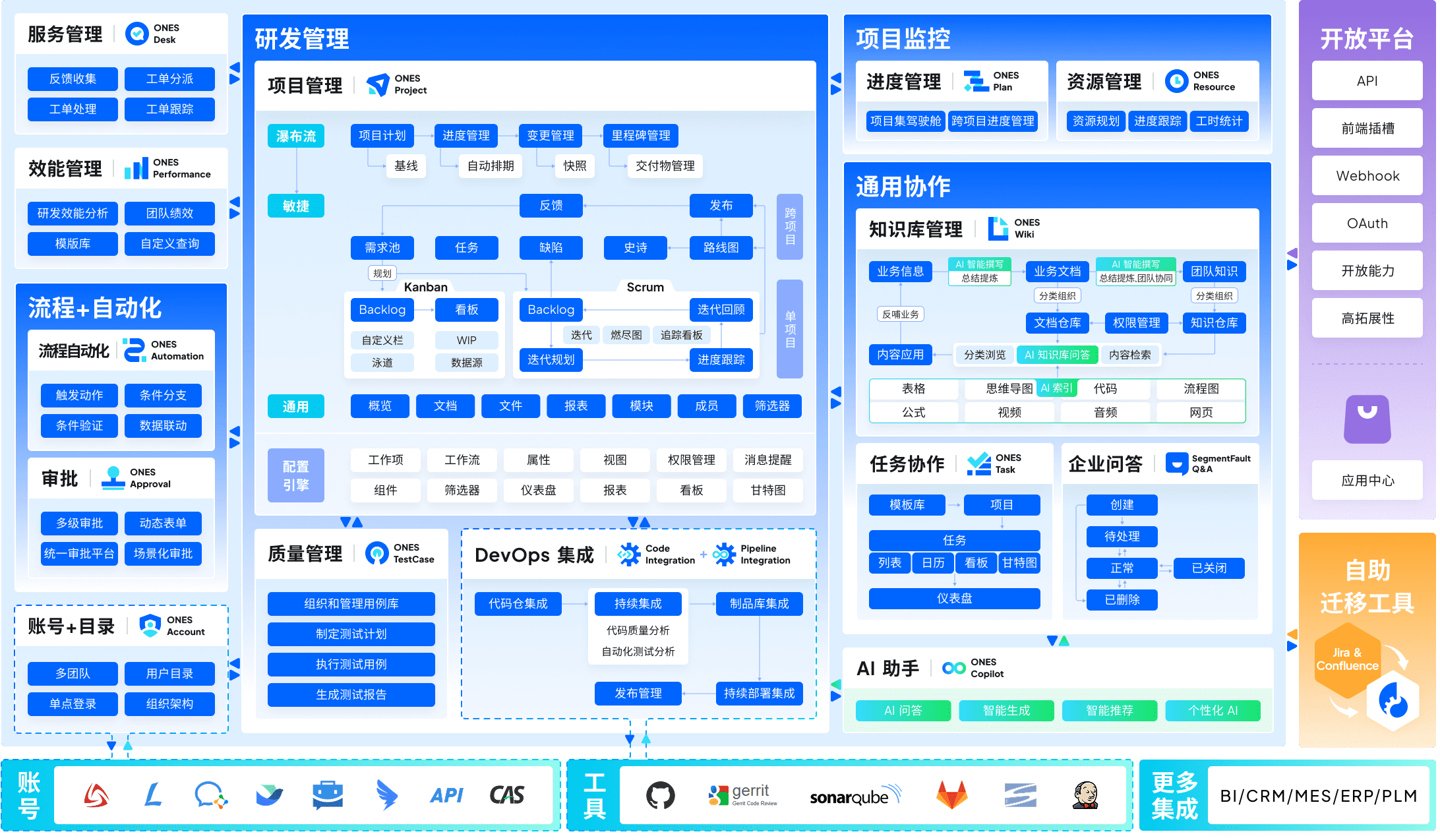
ONES occupies a distinctive position as an enterprise-focused platform that consolidates multiple R&D functions within a single operational layer. Rather than assembling disparate point solutions, organizations can manage project execution, requirement traceability, institutional knowledge, quality assurance, deployment automation, and source control through unified interfaces.
The platform’s architectural emphasis addresses a persistent challenge in scaled engineering: tool fragmentation creates invisible coordination costs. When specifications live in one system, tests in another, and deployment configurations elsewhere, maintaining coherent project visibility becomes prohibitively expensive.
Core capabilities
- End-to-end project and requirement lifecycle management
- Centralized knowledge repository with structured documentation
- Comprehensive test management and quality tracking
- CI/CD pipeline integration and artifact management
- Source code governance and collaboration workflows
- Configurable process engines supporting complex organizational structures
- Granular permission models enabling cross-functional team orchestration
- Research and development efficiency measurement frameworks
Operational scenario
Consider a financial technology company with three hundred engineers distributed across platform, application, and infrastructure divisions. Leadership requires visibility into feature delivery velocity, defect escape rates, and resource allocation without extracting and reconciling data from seven separate systems.
ONES enables standardized workflow definitions while accommodating team-level variation. Platform teams might follow rigorous change advisory protocols; product teams might operate with greater iteration autonomy. The measurement layer aggregates comparable metrics across these heterogeneous operating models, supporting evidence-based process refinement rather than anecdotal assessment.
The platform’s orientation toward data-driven improvement distinguishes it from tools that merely record activity. By correlating process configuration changes with delivery outcomes, organizations can systematically optimize rather than speculate about improvement interventions.
2. Sharkly — Coordination Layer for Human-Agent Teams
Ideal for: Development teams integrating AI agents as active workflow participants.
Sharkly reimagines project management as a shared operational space where human contributors and computational agents possess equivalent task accountability. The platform does not treat AI as peripheral assistance but as first-class workflow members capable of parallel execution.
Core capabilities
- Task-centric work decomposition and assignment
- Concurrent multi-agent execution management
- Connected computational environments and coding runtimes
- Shared contextual memory across human and agent participants
- Reusable agent configurations and capability definitions
- Sprint and project milestone organization
- Execution audit trails and activity logging
- Human acceptance gating before completion
- Integration with existing collaboration infrastructure
Operational scenario
A team building subscription analytics functionality might decompose “develop revenue dashboard” into discrete operations: requirements research, frontend component construction, API endpoint implementation, automated test generation, and documentation updates. Specialized agents execute bounded subtasks while product managers monitor aggregate progress and intervene on blockers. Developers retain responsibility for integration validation and production readiness assessment.
Sharkly’s value lies in providing orchestration without displacing specialized execution tools. Agents might leverage Claude Code, Codex, or comparable systems for implementation; Sharkly governs the surrounding coordination.
3. Jira — Augmented Enterprise Tracking
Ideal for: Established engineering organizations with existing Atlassian investments.
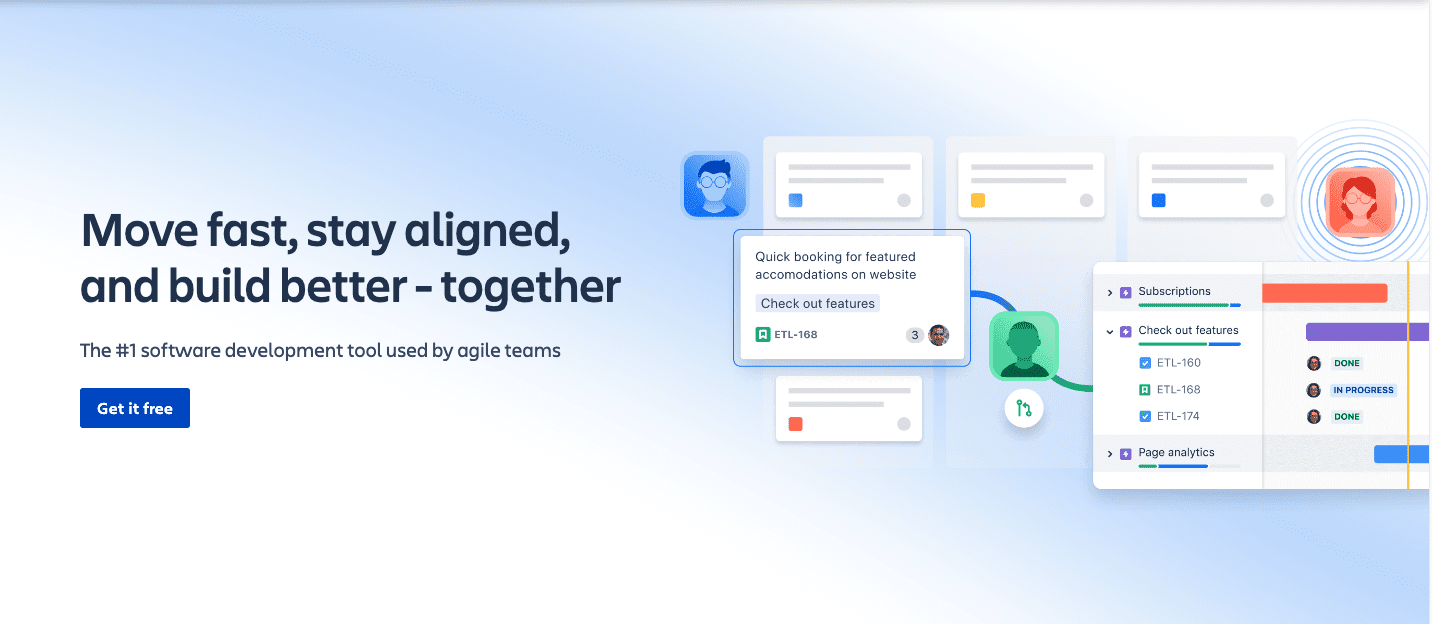
Jira’s enduring prevalence stems from structural depth: sophisticated issue typing, configurable workflows, granular permission schemes, and extensive marketplace extensions. Recent AI additions assist with content summarization, routine task generation, and information retrieval without disrupting established operational patterns.
Core capabilities
- Hierarchical issue and task management
- Scrum and Kanban board visualization
- Backlog prioritization and sprint planning
- Customizable workflow engines
- Analytical reporting and dashboarding
- Development tool chain connectors
- AI-enhanced productivity assistance
Operational scenario
Enterprise engineering divisions managing hundreds of concurrent work items across multiple release trains use Jira’s structural rigor to maintain coordination. AI assistance reduces manual overhead in status compilation and discussion synthesis, allowing project managers to focus on exception handling rather than routine information aggregation.
Adoption calculus favors organizations where migration costs would exceed incremental efficiency gains from alternative platforms.
4. Linear — Velocity-Focused Product Development
Ideal for: Product-oriented teams prioritizing interface responsiveness and workflow minimalism.
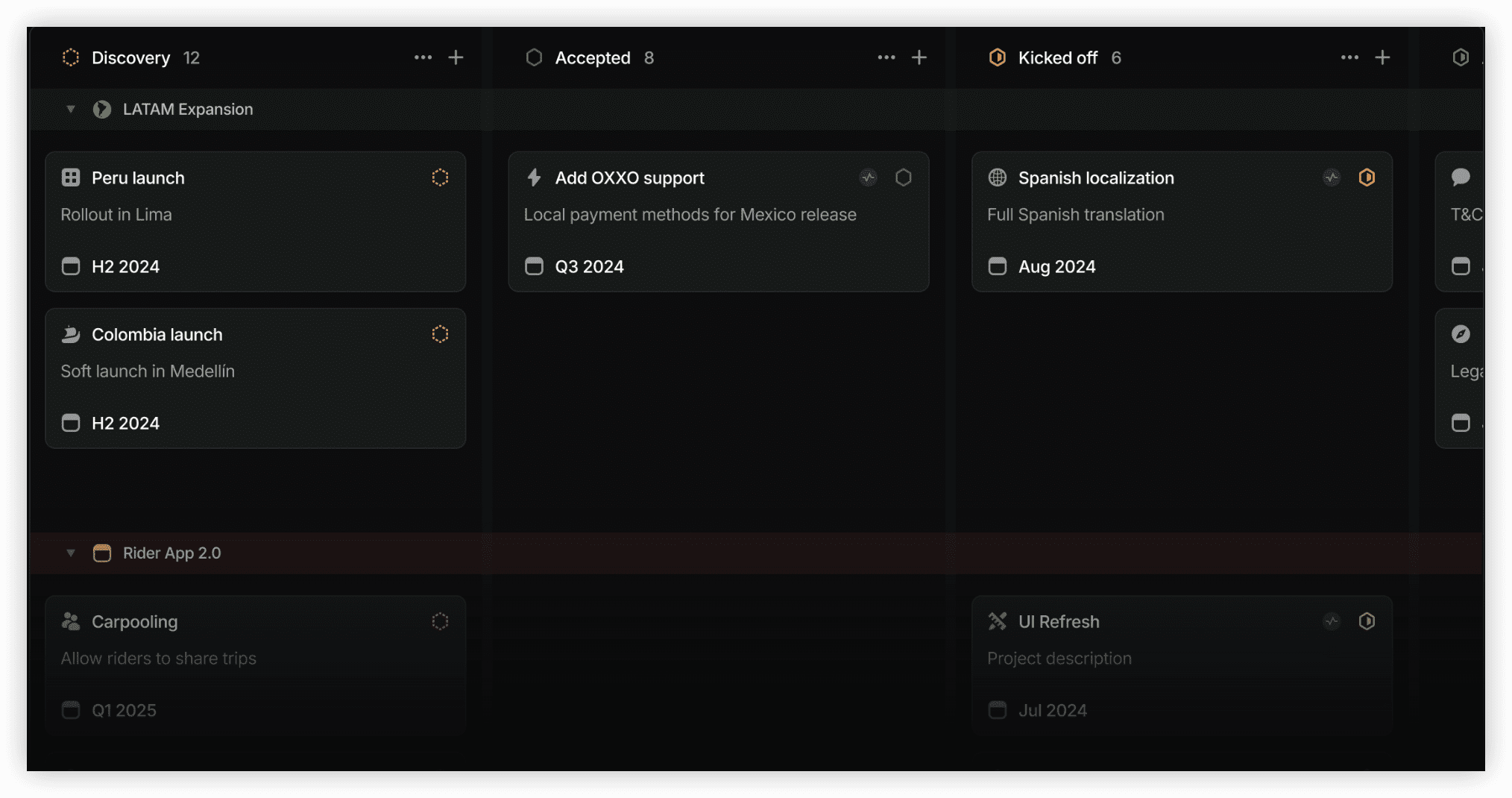
Linear has cultivated preference among startup and growth-stage engineering organizations by eliminating administrative friction. The design philosophy centers on rapid issue creation, intuitive cycle planning, and seamless GitHub synchronization.
Core capabilities
- Streamlined issue tracking with keyboard-driven interaction
- Project and roadmap visualization
- Time-bounded cycle management
- Team-specific workflow customization
- Native GitHub integration
- Rule-based automation
- AI-assisted issue drafting and organization
Operational scenario
A five-person SaaS team organizes quarterly objectives into projects, monthly delivery into cycles, and daily execution into individual issues. AI reduces overhead in issue creation and categorization, while developers focus on implementation and peer review. The lightweight structure suits teams where process ceremony would impede rather than enable delivery.
5. GitHub Projects — Repository-Adjacent Planning
Ideal for: Teams whose primary operational context already exists within GitHub.
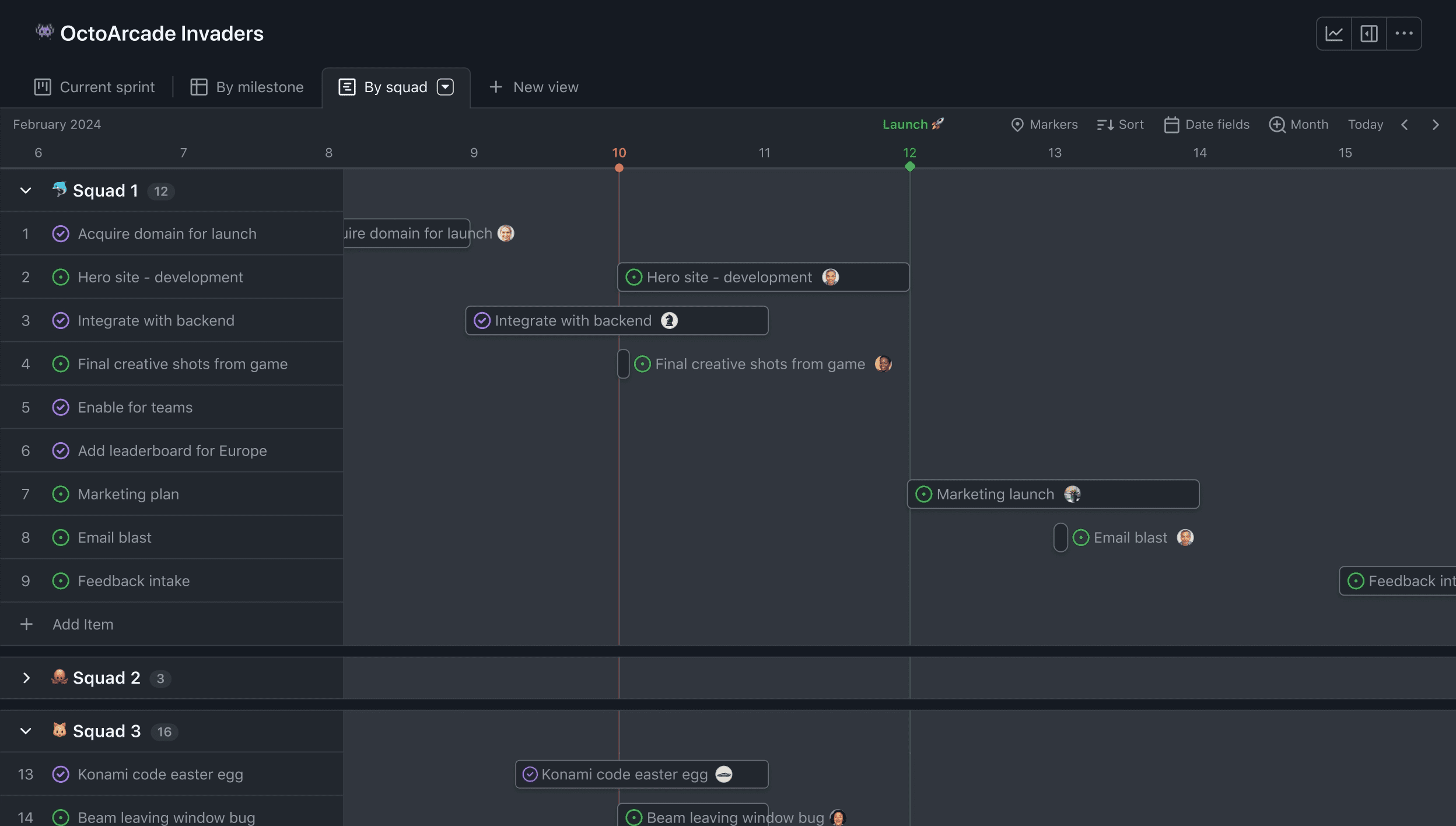
GitHub Projects extends the platform’s version control and collaboration foundation into planning and tracking. Proximity to source code reduces context switching and enables tight coupling between work definition and implementation.
Core capabilities
- Native issue management
- Flexible project board configuration
- Custom field extensions
- Roadmap timeline views
- Pull request linkage and automation
- GitHub Actions workflow orchestration
- Emerging AI coding agent ecosystem integration
Operational scenario
A team defines feature requirements as issues, associates them with implementation branches, validates through automated checks triggered on pull request creation, and closes work items upon merge completion. AI agents operating against repository tasks report progress within the same interface developers use for code review, creating unified visibility across human and automated contributions.
For GitHub-centric operations, supplementary planning tools may introduce unnecessary complexity.
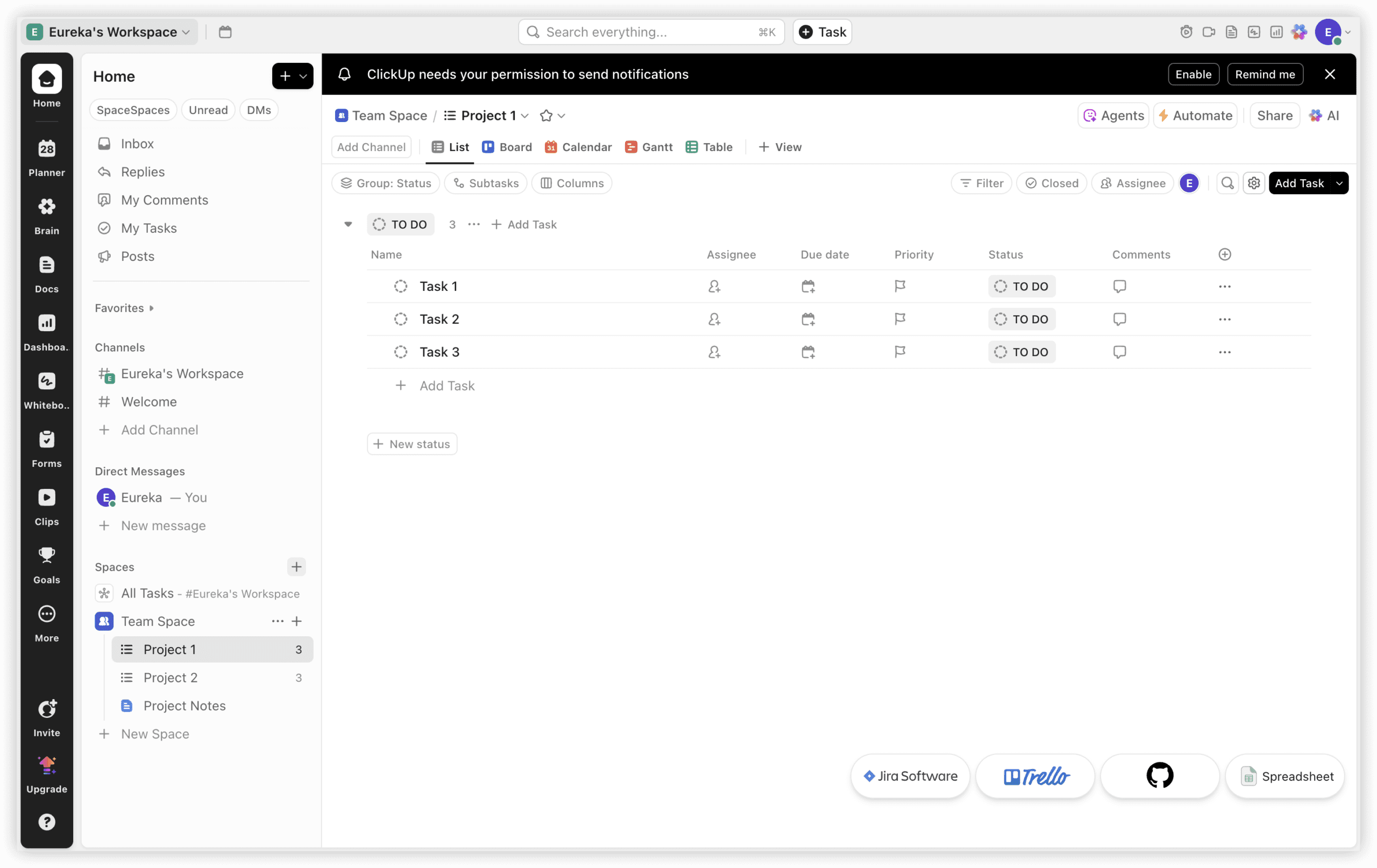
6. ClickUp — Consolidated Organizational Workspaces
Ideal for: Organizations seeking unified environments spanning multiple functional domains.
ClickUp’s breadth encompasses task management, document collaboration, objective tracking, and operational planning beyond engineering boundaries. Its AI capabilities support writing assistance, content condensation, and task-related automation across these diverse use cases.
Core capabilities
- Multi-modal task and project management
- Rich document creation and editing
- Goal and target tracking
- Customizable dashboard composition
- Cross-functional workflow automation
- Team collaboration spaces
- General-purpose AI productivity enhancement
Operational scenario
A software company coordinates engineering sprints, product requirement documentation, marketing campaign planning, and design asset reviews within a single environment. This consolidation benefits operational coherence but may compromise depth in specialized engineering workflows compared to purpose-built development tools.
7. Asana — Cross-Functional Project Orchestration
Ideal for: Organizations where software delivery intersects extensively with business operations.
Asana facilitates coordination across departmental boundaries, making it suitable when engineering work interdependencies with marketing, sales, customer success, and design functions require shared visibility.
Core capabilities
- Structured task and project organization
- Timeline and dependency visualization
- Configurable workflow automation
- Organizational goal alignment
- Multi-stakeholder collaboration interfaces
- Repetitive task streamlining
- AI-supported work management assistance
Operational scenario
A product launch requires parallel execution: engineering completes feature implementation, marketing prepares promotional materials, design finalizes visual assets, and customer success develops onboarding resources. Asana provides unified project visualization while AI reduces manual overhead in status summarization and task organization.
Traditional and AI-Assisted Workflow Comparison
The fundamental structural shift in project management involves expanding tracked participants from exclusively human contributors to mixed human-agent teams.
Conventional sequence:
Requirement definition → Task creation → Human assignment → Implementation → Peer review → Release authorization
Emerging sequence:
Requirement definition → Task creation → Human or agent assignment → Execution → Automated validation → Evidence compilation → Human review → Release authorization
This evolution introduces new coordination responsibilities. Project managers must now determine appropriate agent task allocation, verify contextual sufficiency, manage permission scoping, validate output correctness, adjudicate conflicting modifications, and confirm production readiness. The role transforms from direct task supervision to orchestration of increasingly autonomous participants.
Selection Framework for 2026
Platform selection should reflect organizational context rather than feature enumeration.
Consider ONES when: Your organization operates at scale with complex governance requirements, needs unified visibility across multiple R&D functions, and prioritizes systematic measurement-driven process improvement.
Consider Sharkly when: Your team actively integrates AI agents into development workflows and requires explicit coordination mechanisms for human-agent collaboration.
Consider Jira when: Existing organizational investment in Atlassian infrastructure creates high migration costs, or when sophisticated workflow customization and extensive reporting are non-negotiable.
Consider Linear when: Team culture values operational velocity and interface simplicity over configurability depth.
Consider GitHub Projects when: Development activity already concentrates within GitHub, and planning tool separation would create friction.
Consider ClickUp when: Engineering represents one component of broader organizational coordination needs requiring unified tooling.
Consider Asana when: Cross-functional interdependencies dominate operational complexity.
Frequently Asked Questions
How do AI project management tools handle security and access control for automated agents?
Leading platforms implement scoped permissions where agents receive narrowly defined access rights—specific repositories, designated environments, or bounded API interactions—rather than broad system privileges. Audit logging captures agent activities with equivalent granularity to human actions, enabling compliance review and anomaly detection.
What indicators suggest an organization is ready to adopt agent-inclusive workflow management?
Readiness typically correlates with three conditions: existing AI coding tool adoption by individual developers, standardized task decomposition practices that agents can interpret, and established review cultures where human validation is already routine rather than exceptional.
Can these platforms accommodate hybrid teams with varying AI adoption maturity?
Well-designed systems support gradual transition. Work assignment mechanisms distinguish human-executable and agent-executable tasks without requiring universal adoption. Teams can experiment with agent participation on bounded initiatives while maintaining conventional workflows elsewhere.
How should success metrics evolve when incorporating AI agents?
Traditional throughput measures require supplementation with quality indicators: review rejection rates for agent outputs, iteration counts before acceptance, incident correlation with agent-generated changes, and contextual overhead required to produce acceptable results. The objective remains sustainable velocity, not mere output volume.
What risks accompany excessive reliance on AI workflow automation?
Primary concerns include erosion of institutional knowledge as decision rationale becomes opaque, complacency in human oversight leading to undetected errors at scale, and system fragility when edge cases exceed agent training distributions. Effective implementations maintain human accountability for consequential decisions regardless of automation depth.